|
 |
|
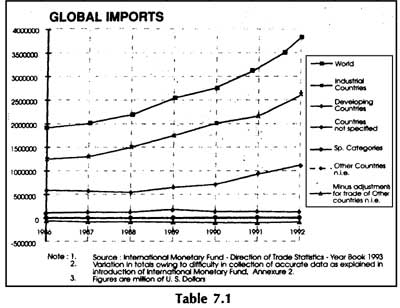
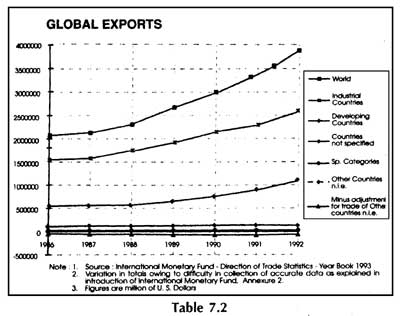
Volume and Composition of Global Trade Global trade is characterised by large shifts in the economic fortunes of nations and their firms. Global trade provides an opportunity to increase national productivity by eliminating the need to produce all goods and services within the nation itself, with the nation thereby specialising in those industries in which its firms are relatively more productive, and importing those products in which its firms are less productive. Imports and exports are therefore integral to productivity growth. National productivity can also be increased by establishing foreign subsidiaries which deal in activities that are less productive at home or which deal in activities that are less productive at home or which perform selected activities abroad that support greater penetration of foreign markets. This not only increases exports but can earn foreign exchange that flows back to boost national income. Thus global competition helps raise productivity over a period of time. But in the process market positions in some segments will necessarily be lost if the national economy is to progress. Subsidies, protection and other forms of intervention to maintain such industries tend to slow down the upgrading of the economy. International competition, on the other hand, creates for each industry a productivity standard necessary to meet foreign rivals. Much of world trade takes place between advanced industrial nations with similar factor endowments. At the same time, there is a large and growing volume of trade in products whose manufacture involves similar factor proportions and in trade which involves exports and imports between the different national subsidiaries of multi-national firms. As Tables 7.1 and 7.2 indicate, world imports for the year amounted to US$3846 billion and corresponding world exports totaled US$3687 billion in the year 1992. Direction of Global Trade Global trade is dominated by industrially advanced countries, since from 1975-86 only about 20 to 22 per cent of total trade originated with the non-oil exporting, developing countries of Africa, Asia and Latin America. Total economic activity - or world gross national product - shows a similar division between two groups of countries, with advanced nations accounting for over 80 per cent of the GNP of the hitherto non-communist world. Geographic proximity is important in determining a country's major trading partners. For example, over 50 per cent of the former West Germany's annual trade takes place with the neighbouring countries of UK, Switzerland, France, Sweden, the Netherlands, Italy, Denmark, Belgium and Austria. The same can be said of some other European countries. The majority of Canada's exports go the USA and her imports also come principally from the USA. The pattern is similar in the case of Mexico which shares a border with the USA. Though geographic proximity is important in determining trading partners, it must also be supported by efficient transportation and communications systems. It is notable that many Latin American, African and Asian countries, despite their geographical proximity, do not substantially trade with one another because they are not well-linked by land, transport and communications, systems. In general, it is global business activity among the advanced, industrialised countries which is the greatest in volume and which has been growing most rapidly. These countries absorb not only the large bulk of exports from developing countries but also account for a large portion of trade with each other.
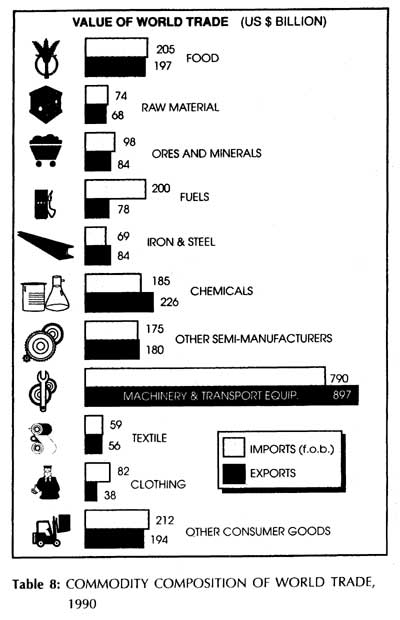
The USA is one of the world's largest nations, yet it is one of the least dependent countries with respect to the share that global trade represents in its total economic activity. Only about four per cent of its GNP is accounted for by exports. Despite this, the USA, because of its large economy, is the world's largest trader, accounting for 15 per cent of world exports. Countries at low levels of development tend to be heavily depended for their export trade on primary commodities and intermediate goods using low levels of technology and relatively simple manufacturing processes. Their imports, on the other hand, are heavily oriented towards manufactured goods and services. Many African and Asian countries, for example, continue to export minerals and agricultural products, and import machinery and manufactured goods from the developed world. Countries that are industrially advanced, such as the USA tend to export advanced manufactured goods and sophisticated services such as financial services, insurance and transportation. Their imports tend to be heavily oriented towards fuel, minerals, raw materials and a diversity of simply manufactured goods, such as garments and light engineering goods like tools and hardware. Composition of Trade From Table 8, it is evident that half of this trade comprises food and fuels in the primary products sector and machinery and transport equipment in the manufactured goods sector.
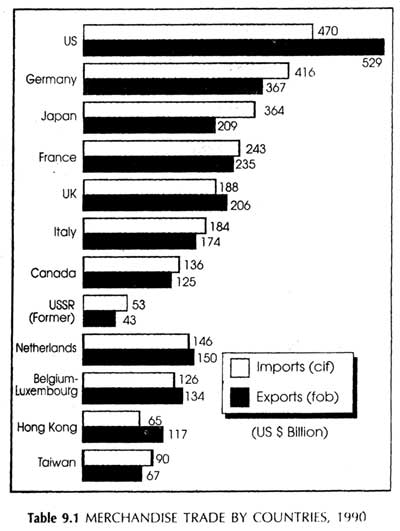
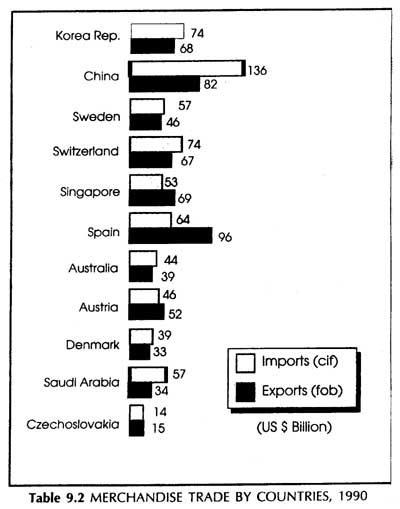
Trade by Nations Table 9.1 and 9.2 prove that the USA, Germany, Japan, France and the United Kingdom are the major importers and exporters in the arena of global trade.
|