|
 |
|
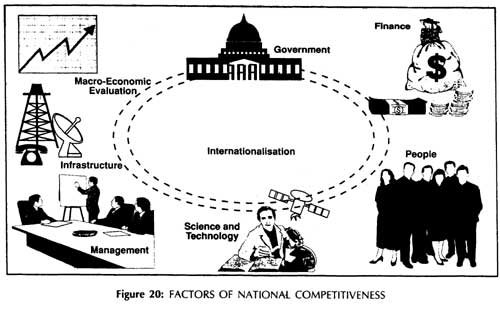
Comparative versus Competitive Advantage The classical theory of comparative advantage holds that countries are better off if they trade in products or services that give them the greatest advantage, or least disadvantage, relative to their trading partners. The idea of competitive advantage however, goes further. As elaborated in the World Competitiveness Report, one of the most comprehensive documents on the subject (compiled by World Economic Forum and International Institute for Management Development, Lausanne, Switzerland) annually, an instance of comparative advantage can be based on having an abundance of natural resources such as oil. Competitive advantage, however, can only be based on the entrepreneurial ability to add value to such natural resources. In this case, for example, by refining the crude oil, the abundance of low cost labour may initially result in competitive advantage for a country, but a consequent growth in economic activity will then increase the demand of labour, leading to higher wages. Meanwhile if the country has not invested in the education of its people, and the upgraduation of their skills, its competitive edge will be lost at the point its cost of labour reaches the level of that of its competitors. However, if the labour force has in the meantime been educated and their skills enhanced, the value added will justify the increase in wages, and the country in question will be in a position to sustain its competitive advantage, as the quality of its work force will match that of its competitors. Competiveness of Nations It has been continuously demonstrated that the key to competitiveness lies in the implementation process. Transformation of ideas and technologies in products is crucial, and Japan, Germany, Taiwan, Sweden and Singapore are among the countries that have mastered this process. Being merely innovative as in the case of the USA, UK or France, or just having an abundance of natural resources and raw materials as do Canada, Brazil and India, is not enough, implementation is vital as "doing things right is no less important than doing the right thing". Thus without discounting the importance of say, technology or market forces, the fact remains that countries and enterprises that implement well, that are therefore process driven, are countries that maintain a competitive advantage. Eight key factors of competitives are listed by the world Competitiveness Report and it is assumed that the higher the quality find quantity of the factors, the more successful a country will be at adding economic value and selling its products in the domestic and global trade arena. These factors are briefly described below: Macro economic development of the economy: This covers size of the economy and investment, inflation and economic lewth, economic flexibility and the relative importance of various economic sectors. The basic economic indicators of GNP growth, capital formation and value of currency are the criteria used to judge the relative strength of the economy. Internationalisation of the economy: This reviews a nation's performance in trade and investment, taking into account it openness to foreign business, its levels of protectionism, with the objective of evaluating its integration into the global economy. The government: This includes the government's debt, reserves tax and revenue rates. Governmental policy and action, impacts the state of the economy, including the legislative environment, and monetary and fiscal policies are also considered here, as are the socio-political stability of the government the government's responsiveness to global economic change and laws regarding competition. Finance: The key criteria examined within the framework of factor are the efficiency and diversity of capital markets and quality of financial services. These criteria evaluate the real maturity of financial markets and the extent to which they conducive to entrepreneurial risk taking, and include areas as interest rates, size of banks, capitalization of stock markets, availability of venture capital. Infrastructure: Considered here are resources and infrastructure their adequacy for business and their optimum deployment. Also reviewed are information, communications and transportation systems. Management: Management examines the extent to which enterprises are managed innovatively, profitably and responsibly. Indicators of product quality, competitive pricing, business efficiency through productivity, use of technology and employee relations are among the criteria that are applicable. Science and technology: This takes into account the scientific and technological capacity, together with the development of basic and applied research. Patronage by government and industries science and technology are considered here, as well as a country's investment levels in these areas. In overall terms, this factors evaluates the degree that R & D is integrated into business activities.
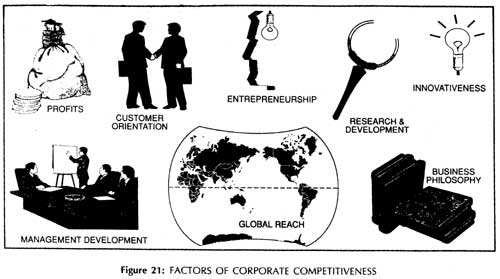
People: This factor looks at investment in education, literacy types and levels of education, motivation and skills of labour, the attitude to work, the value systems and the quality of life society. Rankings are carried out of the above criteria using the standard deviation method, thus assessing a country's performance in relation to other countries in its specific group. To groups are therefore not comparable in their levels of competitiveness. Information is collated by means of an annual questionnaire circulated worldwide to key people in business, industry and government, which is followed by a comprehensive analysis. The results show how countries rank in their competitiveness. It is found that Japan, Germany and Switzerland hold the top positions in the industrialised world, with Portugal, Spain and Greece occupying the lowest rung of the relative competitiveness ladder within the same group. In the second grouping of currently industrialising countries, Singapore, Hong Kong and Taiwan come out on top, and Brazil, Hungary and Pakistan bring up the rear. It must be noted however, that this method has its own limitations any may not be construed as fool-proof. Weightage given to indidual factors, for example, is a consideration here. In actual practice, over-emphasis on a certain factor or group of factors for whatever reason, may skew the findings, and therefore result in flawed decision-making. Accuracy of data collected is also another point in question and selection of sample types and/or sizes may also be open to error or bias. Moreover, any degree of subjectivity which enters into the research and information-gathering process devalues the application of this method for entrepreneurial judgment. Therefore, it is important that one makes a personal entrepreneurial judgement of each selected country as a backup to any desk data or research carried out as outlined above. Koh Boon Hwee, chairman of the Board of Singapore Telecommunications Pvt Ltd, feels that one should not be limited by the size of one's country and population but should assume an international outlook and adjust to global challenges. His principle is that "we must globalise our business, offer superior customer service, invest in world class infrastructure." Competitive advantage, states Michael E. Porter in his book, The Competitive Advantage of Nations is created and sustained through a highly localised process. Differences in national economic structures, values, cultures, institutions and histories contribute profoundly to competitive success, and a theory of competitive advantage must reflect a rich conception of competition that includes segmented market, differentiated products, technology differences and economies of scale. Such a theory must also take into account, he continues, the fact the competition is dynamic and evolving, and that improvements and innovation in methods and technology are central to the issue of competitiveness. Elements of Corporate Competitiveness. Competitiveness exists in domestic and global markets through products and services that are created to satisfy customer needs. Corporate competitiveness is a function of the various factors described below : Profits: The ultimate test of business efficiency is profits and this, in turn, is a function of other subcriteria such as productivity which in itself is a function of Labour/Capital ratios and the price? quality ratio. Research & Development: The potential competitiveness of a firm can also be judged by its long-term view and its investment in R & D. Entrepreneurship: The entrepreneurship level of a corporation be judged through factors such as the willingness to take risks as also the ability to venture into new markets, new opportunitie, new products and new ideas. Management Development: This can be evaluated through a review of the level of delegation in an organisation, the level information technology, long and medium-range planning and orientation. Business Philosophy: The business philosophy of an organization can be seen through its employee relationships, the morale and managerial constraints or flexibility. Customer Orientation: As customers get increasingly know ledgeable and demanding and familiar with alternatives on account of rapidly growing communications systems via improved computer networking, telephone/fax systems and satellite television, global competitiveness can be judged by how customer-oriented companies are. Global Reach of Companies: Companies with the widest possible global reach have the best advantage. Strong Home Base: A global company with a strong home base provides the best competitive advantage to back up its operations. Efficient and Flexible Organisation: Efficiency and flexibility of an organization are other keys for the successful deployment of global resources competitively.
Innovativeness: Companies must be innovative and anticipate customer needs. Proactive Orientation: Companies need to be proactive as opposed to reactive and should find ways to anticipate customer needs of the future, catering to those needs ahead of the competition. Thus corporate competitiveness is a function of various fact that need to be carefully developed in an organisation in order attain a long-term competitive edge. MITSUI - ADAPTING TO CHANGE A clear illustration of a company reacting well to change is Mitsui & Co., a Japanese firm which has over 9000 employees in Japan. Their 300 foreign affiliates employ some 3700 persons around world. Mitsui's information gathering and communications system is considered the best in the world. Traditionally, the company's focus was on commodities, but with the sharp appreciation of the yen and the falling prices of raw materials such as crude oil, and confronted with structured changes both at home and abroad Mitsui has shifted to new growth areas such as services, electronics and biotechnology. Following the deregulation of the telecommunications systems in Japan, the company participated in new telecommunications carriers and began marketing data bases, on-line information services and software globally. Capitalising on its worldwide network and experience transportation and distribution, it invested in the establishment a "non-vessel operating common carrier". The system operates vessels but provides information on a fully integrated set of sea, air and land transport services and arranges services where they are required. Mitsui has also diversified into a growing range of financial services such as dealer and customer financing, project and lease financing, corporate and mortgage loans. It also rents office space, consultation and secretarial services to foreign business persons in Japan through the Tokyo Executive Centre Inc.
In the twenty-first century, Mitsui may no longer trade primarily
in commodities. Rather, it may be a diversified services company. |