|
 |
|
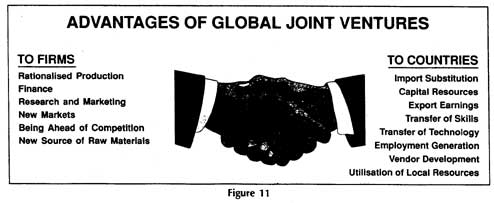
Global Firms, Direct Foreign Investments and Joint Ventures Direct Foreign Investment (DFI) has been a major force in increasing the process of global business activity, which has in turn accelerated the process of world economic development and has contributed to the expansion of the global economy. According to John D. Dunning's 'eclectic theory' of foreign investment, there are three sets of determinants of DFI. The ownership advantage is considered necessary to outweigh the disadvantage of being foreign. This could be in the form of either a monopoly over a product or brand name, a patent on a production process or technology, or a superior knowledge of the market and marketing techniques. The second factor is that the host country must have some locational advantage in terms of serving its market or as an export base. Easy availability of high quality, low wage labour and relatively low wage transportation costs could also reflect locational advantage, so would policy determined costs arising from trade restrictions, labour legislation, pollution controls or restrictions on direct investment in the host country. The relationship between the USA and Mexico is a case in point. The availability of an industrially disciplined and low-cost labour force, combined with a desire to increase exports, prompted Mexico to set up its maquiladora programme in 1965. This programme enjoys preferential tax treatment from the USA as well as privileges in Mexico such as 100 per cent foreign equity ownership. Known also as twin plants or in-bond manufacturing, it permits manufacturers to import into Mexico raw materials, components and machinery free of import duty, provided most of the output is exported. Similar zones also exist in various countries in Asia. Both Mexico's proximity to US markets and its low wage structure have contributed to the popularity of the twin plant concept among US global corporations. Many US manufacturers have moved to "just-in-time" inventory systems, as the quick delivery possible from Mexican border towns gives them an additional edge over Asian alternatives. Moreover, at about US$25 per week, the average wage rate for unskilled labour in Mexico in 1992 was one sixth that of Japan and about one half that of Hong Kong, the Republic of Korea, Singapore and Taiwan. The third set of determinants relates to the intemalisation advantage. Here, investment follows when conditions make the external market more profitable than the internal. This is true particularly when vertical integration brings the supplier-customer relationship within the company, thus inducing the investing firm to choose direct investment over other arrangements such as production licensing. Advantages of Global Joint Ventures to National Economies of Developing Countries Some common characteristics of developing countries are poor quality of life, rapid population growth, rapid urbanisation, poor level of education, shortage of technology, poor capital formation, under-employment and unemployment and uneven distribution of income. Global Joint Ventures and DFI bring such countries certain advantages, some of which are described below. Capital resources Global joint venture partners bring in equity capital, thus sharing the financial cost of project promotion with the host country, that too in the form of scarce foreign exchange. Foreign exchange flows in at the time of investment, and may do so once again, this time on a steady basis, when exports commence. Transfer of technology Joint venture partners bring the technology for the manufacturing process, as with for example, the case of American steel companies setting up operations in China. Technology refers to the collective knowledge gained over a period of time, covering the gamut from R & D to design construction, manufacturing and processing facilities. As this is a process that is evolved over time and at high cost, the host country saves on investment in parallel efforts. Vendor development Joint ventures appoint dealers and local vendors resulting in a dispersal of technology and business skills development. This has happened in Malaysia, for instance, where Japanese companies manufacture cars. Gradually some parts were locally manufactured, resulting both in dispersal of technology and vendor development. Import substitution Since joint ventures based on sophisticated technology produce goods using some local raw materials, these generally replace imported products. Joint ventures hence contribute to import substitution, saving on valuable foreign exchange which can then be better utilised, as in the case of Glaxo's manufacturing pharmaceuticals locally in Africa, for example. Export earnings Many joint ventures are partly or wholly export-oriented, specially in the developing countries, since the developed country export its technology and creates new products which are exported to other countries, in some cases even exported to the parent country as this may be cost beneficial due to lower comparative costs. This again earns valuable foreign exchange for the host country. Employment generation Most developing countries are not only grappling with lack of sophisticated technology but also with the problem of rising population. Joint ventures generate jobs and make some contribution to a reduction in the unemployment level due to the lack of industries. Transfer of skills Entrepreneurs who participate in joint ventures also acquire related skills from their more experienced partners. The host country also generally introduces new technology and trains personnel to operate the new machines, etc. resulting in a transfer of skills. This for example, is what happened on a major scale when after World War II, the process of industrialisation commenced in several countries newly independent from colonial powers. Core sector industries such as transportation, road-building, and steel acquiring the skills and technology for steel manufacture from the former USSR, Germany, Britain and the USA. Utilisation of local resources Many local resources in developing countries (say mineral wealth, seafood) lie underutilised or unutilised. Several countries are not aware of their own factor endowment and these factors are used to an advantage by the technological superior partner in a joint venture.
Sharing of wealth Joint ventures have stock option plans for country nationals and thus share wealth. The prevailing conditions in the host country are important in determining what effect DFI and joint ventures have on the economy. Some of these preconditions that could enable optimum benefits from DFIs are:
Disadvantages of Global joint Ventures as Perceived by Host Countries Restricting or allocating markets among subsidiaries. The host firm generally has an existing marketing set-up operating from the parer company headquarters which markets the products from the new venture within an existent framework. Thus the new joint venture may be prevented from developing its own export markets, as was may be prevented from developing its own export markets, as we the case with IBM and Coke in say, Nigeria. A manufacturing subsidiary in this country was not permitted to export to its Africa neighbours, as other company subsidiaries already were in existence there. Over invoicing equipment and spare parts exported and overcharging for transfer of technology and management, thus making no real equity contribution. For example, in order to cover the risk of capital investment, plant and machinery may well be over invoiced. Extracting excessive profits and fees based on monopolistic advantage and 'price-fixing'. Most home firms take advantage of the fact that the technology they possess cannot be availed of easily. Financing their entry" mainly through local debt and retiming a majority or even TOO per cent equity with the parent. Diverting local savings away from productive investment by nationals. Diverting away the most talented personnel. Restricting access to modem technology by centralising research facilities in the home country and by licensing subsidiaries to use only limited or outmoded technology. Dumping unwanted technology and even banned products, especially medicines and chemical products, jeopardising the health and life of the host countries' populations. Restricting the learning' process by staffing key technical and managerial positions with expatriates. In many developing countries there are plenty of trained and skilled technical personnel who can take over key positions with little or no on-the-job training. Not taking a keen enough interest in training and developing personnel. Showing scant respect for social customs, believing that what worked at home should work anywhere. Acting contrary to objectives of national plans. Contributing to price inflation by producing unnecessary goods with scarce resources. Dominating key industrial sectors. Manipulating local laws by bribing officials, thus gaining substantial financial gains at the cost of the local community.
Manipulating foreign policy of host countries in favour of their home country. Controls Effected by Governments to Regulate Foreign Investment and Joint Ventures Host countries change their policy towards joint ventures from time to time depending on their needs and on the amount of benefit derived from foreign investment. Some of the controls effected are:
Thus when foreign investment or a joint venture is approved in Indonesia, for instance, several stipulations accompany the approval. These include the condition that foreign investment should reduce to 20 per cent over a period of 5 years, that a maximum of 5 foreigners may be employed, and that only in an area where Indonesians are not adequately trained or available. In India too, phased manufacturing programmes are often undertaken, with a good case in point being the Suzuki collaboration with Maruti, a government company. This venture commenced with almost 100 per cent imports from Japan, phased out over time to a level of about 20 per cent. Good and Bad Direct Foreign Investment - A Point of View Kiyoshi Kojima, in his book Direct Foreign Investment (Croom Helm, London) has propounded a contrasting set of motivations and consequences of direct foreign investments - the Japanese and the American. According to him, the Japanese motivation is beneficial to all partners and is in the interest, of expansion of global trade cooperation and eventual equalization of levels of technological development. The other, he says, is short-term, beneficial only to the oligopolistic multinational corporations and detrimental to global trade and cooperation. His argument is as follows: Direct foreign investment is an extension of the product tife cycle concept, hence direct foreign investment should take place in industries in which the home country has a comparative disadvantage and the host country a comparative advantage, e.g. textiles in Japan. In such an instance the host country will gradually evolve to a level on par with the technology exporting country, i.e. a country which Japan has exported technology to, will eventually take advantage of its own cheap labour and export to Japan, (as say with textiles made in Indonesia and Thailand for export to Japan) while the advanced country's investment will have moved on to areas of comparative advantage. This is to say, by virtue of its overall technological advancement, its investment will shift to a comparatively advantageous industry like computers where low labour levels are needed. In the process, trade is accelerated, local jobs are not sacrificed and simultaneously another country is helped to raise its level of technology and consequently its level of development. Kojima argues that the American approach is exactly the opposite. He states that American global corporations have large resources and high labour costs, face overseas tariff barriers and need to protect their oligopolistic advantage. They therefore resort to direct foreign investment in areas where they enjoy maximum comparative advantage in the home country, e.g. computers, chemicals, scientific instruments and so on. This results in a loss of foreign exchange for the home country by increases in its imports, loss of jobs due to overseas investment and the transfer of resources overseas. This pattern of investment, continues Kojima, is elected in spite the fact that host countries may not be at levels of technological development compatible with these industries and therefore may enjoy structured development in stages, but may be forced to mechanically reproduce processes which have no relevance to level of their own development. The American multinational corporations main advantages are using their advanced R & D in home countries, high-powered advertising, advanced information networks, patents and brand names, plus available financial yrces which help them to achieve their oligopolistic objectives. All this is a loss to both home and host country, argues Kojima, and is not trade-oriented. While Kojima is right in asserting that the nature and type direct foreign investment and joint venture industry should depend on the needs and abilities of the host country, the actual effect of the economy of the home country depends on what the county would have done had this overseas investment not taken place i.e. whether it substitutes domestic investment or domesth consumption or both, and its effect on imports and exports. The effect on the host country with reference to the above depends or the level of technology and employment and the potential to internal investments. It cannot, thus, be said that American global corporations and any different from global corporations from other countries, including Japan, and this is evident from the types of joint ventures throughout the world, especially those in developing countries and the visible contribution they make to growth and prosperity Hewlett Packard and IBM are both cases in point. Code of Conduct for Global Joint Ventures Various mechanisms exist to regulate the functioning of global corporations. Some of these are the Foreign Investment Code of the Andean Group 1970, the Guidelines for Multinational Enterprises of the UN Commission on Transnational Corporations, the Declaration of International Investment of Multinational Enterprises of June 1976 of the OECD, etc. Besides these mechanisms there are various other instrument of the OECD, the World Bank Council for High Economist development, the UNCTAD, the Council of Europe and other international agencies that regulate various aspects of translation, corporations. Under preparation at the UN is a code of conduct for transnational corporations. Broadly speaking, the need for the cod rests on the evolutionary nature of international norms, the desire to minimise the negative effects of the operations of global firms and to maximise their positive contributions to economic growth and development in the context of an interdependent world. Thus it is in the interest of all states to adopt a code of conduct which, in a balanced marrner, sets out the rights and expectations of the international community with regard to global firms. The need for the code has been recognized by organizations of business, labour, consumers and environmentalists. Thus at the hearings on the status of the code negotiations held on May 7, 1987 by the Subcommittee of Human Rights and International Organisations of the Committee of Foreign Affairs of the United States House of Representatives, Ms Esther Peterson, representative of the International Organisation of Consumer Unions to the United Nations, testified as follows: "The potential benefits of the code are easily demonstrated. The Bhopal tragedy, for example, might have been prevented or at least mitigated if the disclosure and environmental standards mandated by the code had been in effect. These standards would require TNCs not only to conduct their operations in accordance with the laws and regulations of the government of the host country relating to preservation of the environment but also, in conducting their activities, to take steps to protect the environment. The code would also require TNCs to supply the authorities of the government of the host country with information on the possible environmental impact of their products and production processes. Moreover the code's rules on jurisdiction over TNCs would have clarified and helped resolve the ensuing legal disputes. "The code is not, as has been suggested, anti-business or unduly restrictive of TNC operations. To the contrary, the draft of the code now under discussion strikes an equitable balance between the rights and responsibilities of TNCs and governments of host countries. The code's initial focus on corporate conduct has been balanced by provisions that address the responsibilities of governments towards TNCs. These latter provisions, which are still being negotiated, will ensure that TNCs receive fair treatment, including compensation in the event of nationalisation, and that there will be safeguards for any confidential business information that TNCs are required to share with the governments of their host countries. "Moreover, the code provisions limiting TNC activities consist essentially of broad flexible statements of principle; they are not rigid prescriptions for controlling TNC conduct. Their thrust is to maximise the positive contribution of TNCs to the development process by increasing the predictability and stability of the legal environment in which they operate while minimising the negative effects of TNC activities." Types of Global Joint Ventures Evolution of joint ventures The earliest joint ventures between developed and developing countries were in mining and plantations. In these, complete control and ownership was almost invariably vested with the parent firms and local partners had little or no role other than helping in local government-related problems. The establishment of real joint ventures, with both partners playing a significant role, evolved out of the need to locate manufacturing facilities closer to sources of raw materials or markets and various other reasons cited above. Depending on a firm's motivation, the extent of development and potential of a host country would result in direct foreign investment and joint ventures of various types. Some of the more typical ones are as follows: A. Non-investment oriented
This is the case where internationally renowned brands of consumer products can be sold on the strength of established reputations, or when the know-how for production is not desired to be fully transferred in order to maintain patent advantages. B. Investment-oriented
Many combinations of joint ventures are possible. For example:
Role of Governments in Facilitating Direct Foreign Investment Catalyst of change In an Increasingly interdependent world, the government of any country, must be ready to act as a catalyst in the economic development of the country and, together with its people, create the right environment. Friendly environment Developing countries wishing to attract such investment must create friendly environment for global corporations. Rapid integration of financial markets In recent years this has resulted in great interdependence of trade investment and other forms of capital transfer in various countrie: Direct foreign investment follows the path of least resistance an will flow to areas of greatest dynamic growth potential an profitability. A rapid integration of financial markets will facilitate DFI. Right infrastructure The government should develop the right infrastructure, i.e. roads, ports, power, railways, water supply, etc. Investment in R & D The government should invest in R & D to create the culture of research and development and this should preferably be in conjunction with private firms. Good information base The government should also set up a good information base available for sourcing by business and industry. Stable taxation laws The tax policy should be stable and reasonable and not erratic. The authorities should maintamlow levels of taxation and simplified foreign exchange laws which allow free foreign exchange flows. Remittance of profits and dividends The remittance for profits and dividends should be uniform for foreign investors and local firms. Management of red-tapism The nation should have little or no bureaucratic impediments. To authorities could formulate laws and rules allowing the unrestrick entry of foreign investment in general, and reducing the numb of types of investments that need to be screened for approval, subject to the laws of the land which are common to both domestic and foreign investments. Incentives could be granted in certain areas of investment, eliminating/minimising the discretion factor. Investment in education The government should strive for a high level of literacy and a good level of technical/management education. Efficient legal system The country should have an efficient, honest and speedy judicial system. Political stability The country should have a stable political system, preferably a democratic one. Public relations by host countries countries also need to carry out public relations exercises so that conditions in their countries are not mistaken for conditions actually prevalent in neighbouring countries. Active advertising and participation in international trade fairs are one means of carrying out PR exercises to invite direct foreign investment, as are the activities of embassies and consulates, and promotion of a country through traveling businessmen. Government-Business Cooperation Frictions in the relationship between-government and business should be replaced by cooperation. This is taking place in many countries that have seen the growth and development of businesses and economic prosperity, with recent examples in South East Asia being Indonesia, Malaysia and Thailand. The policy of protective restrictions should give way to a more open policy which is absolutely clear and which acts as a springboard for a country and its firmff to gain global competitive advantage. Germany has advanced technologically because its government's role in R & D arid contributions made towards technological development is large. Countries should also take into account development in other countries that could influence the competitive advantage of their firms, changing and adapting their policies accordingly. In fact, they should go so far as to be proactive and anticipate changes in other countries' policies that could affect their own economies. Figure 13
Wooing smaller firms It is a good policy for foreign governments to encourage investments by small and medium-sized global companies that have the capital and technology but lack the ability to scan opportunities globally for profitable investment opportunities. Often prospective partners in certain countries and governments are unaware of these companies which often may be suitable for smaller markets and developing countries : China - An Example of Accelerated DFI A recent and visible example of how government policy can change the direction of foreign investment is China. In fact it is said that the only thing red about the Communist China of today is the carpet laid out for the foreign investor. In the first nine months of 1993 alone, US$83 billion of DFI was contracted in China and US$15 billion of this actually invested (as compared with around US$10 billion over the whole of the previous year). This is to be viewed against the fact that between 1979 and 1987, total DFI approvals in China amounted to US$20 billion, while cumulative inflows of DFI were in the region of US$9 billion. This is mainly due to China's open-door policy for foreign investors - a dramatic reversal of its earlier policy. China was particularly interested in obtaining access to advanced technology, management skills and international distribution channels. The Chinese government took the decision to open to foreign investment 14 coastal cities, Hainan Island, and three delta zones, in addition to the four special economic zones (SEZs), which had been in operation since 1979. Moreover, considerable incentives are extended to foreign investors including preferential tax rates, duty free imports for materials for export production and easy repatriation of profits, dividends and royalties. It takes an average of just two months from the time a DFI application is made to the time that all relevant clearances are obtained. Provinces too have a high degree of autonomy in decision-making: projects up to US$35 million are cleared at this 'level itself with no reference whatsoever to the centre. Advice and Support for Direct Foreign Investments The Foreign Investment Advisory Service (FIAS) co-sponsored by the international Finance Corporation (IFC) - an institution which is part of the World Bank - and the Multilateral Investment in tee Agency (MIGA) have been advising various governments the past five years on how to improve their investment climates. Many countries which in recent years have been successful in DFI policies have one unified authority which considers DFI applications and take across-the-board decisions, e.g. Korea, Thailand, Malaysia, Indonesia and Singapore. |