|
 |
|
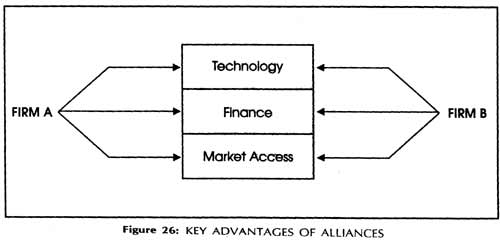
Global tie-ups are motivated by the fact that firms need to gain easy access to new markets, to share costs of expansion, and to increase skills without having to develop them in-house, all of which can take place through a relationship with collaborating partners. Given that the lead time for setting up one's own operations can be considerable, and much expense can be incurred in the process, to say nothing of the level of risk taken, various forms of partnership provide a viable and frequently exercised option, particularly when one is seeking to establish a new business : or develop an already existing business within a new territory. The need for global tie-ups is accelerated by rapid changes taking place in global markets where consumer tastes and preferences are becoming universal on account of ever-increasing exposure to global media. The kind of tie-ups possible include partnerships, wholly owned or subsidiary companies, licencing agreements, distribution agencies and contract manufacturing, as well as joint ventures and strategic alliances. Firms can form alliances with other firms of parallel or complementary interests, where a business relationship may be shared and respective strengths are optimised to build on each other. It is in this area that the advantages of alliances as opposed to it ventures lie: joint ventures entail capital investment in the onto of equity, and there is great pressure on returns from Shareholders and financial institutions alike. In an alliance, however, companies are putting together their existing resources, sometime ; adding further resources, thus optimising their existing strengths and enhancing returns. Several types of alliances are possible, for example entailing joint R & D or entailing access to markets for one partner's product into another partner's area, into a common area, into a new area altogether. Alliances are also possible with more than one partner in various fields. For instance, IBM has successful Japanese operations where it has distribution units with Ricoh, computer integrated manufacturing with Nippon Telephones, and a tie-up with Fuji Bank for financial systems marketing. Corning registers over half its profits from a host of alliances, over two-thirds of them with foreign companies. Advantages of Alliances In an alliance, one partner may initially learn from the other as in the case of UK whisky manufacturers in Japan who first used Japanese distributors, and later chose to go the independent route, thus minimising both cost and risk, and accelerating the process of learning and growth. Glaxo, the British pharmaceutical company, has not been keen to establish a full business system in each country where it has set up business. Given the company's heavy commitment to R & D it did not see how and why it should build a full-scale sales and service network in Japan, for example. What it did was to form alliances with excellent partners in Japan, exchange its best produced with each of them, and focus its own resources on its already established network in Europe, generating greater sales there. India is a good case in point, and a range of options manu available in its liberalised economic environment has resulted an equally wide gamut of strategies for globalisation on the part of international firms. J.P. Morgan, the third largest bank in the US, has in the last few years transformed itself from a conventional commercial bank to a European-style universal bank with a strong emphasis on investment banking and trading functions. The bank's strategy is a global one. It is today the only institution that is a primary government bond dealer in all seven major industrialised countries. The Morgan Guarantee International Finance Corporation has entered the liberalised Indian market via a joint venture with the Industrial Credit and Investment Corporation of India (ICICI). It sees an opportunity for its own traditional multinational clients to expand current investment or to go into new investment. It also helps Indian clients to service their international needs and aids Indian government-owned companies in the process of disinvestment. ICICI's natural strength is with the Indian private sector and J.P. Morgan's is with multinationals. There is expected to be a growth in the agricultural sector in India. The growing demand for pest control products that are high on safety and environmental protection has influenced NOCIL, an Indian company, to sign a memorandum of understanding with Dow Elanco, a global leader in agri-chemical business, to set up a joint venture for producing a variety of products in India. The advantages brought to firms by corporate alliances include:
Alliances and Acquisitions Research reveals that about 50 per cent of cross-national alliances have been successful as opposed to only 25 percent domestic diversification by firms. It is also found that the average life expectancy of an alliance before one or the other partner buys the other one out is about seven years. However, alliances can bring substantial benefits within this time to both parties, particularly when both are prepared to treat alliances as a medium term objective and plan accordingly for the future. The termination of an alliance or its development into an acquisition does not mean that the alliance has been a failure.
For instance, the Sandoz Sankyo alliance resulted in the establishment an independent business for Sandoz in Japan, thus fulfilling Saridoz's goal and making Sandoz one of the top 25 companies in Japan today. The Japanese partners meanwhile gained access to markets in the Western Europe, which they continue to take advantage of. Similarly, Bayer's alliance with Takeda ended on a happy note, in which a long-standing sales agreement with Takeda was terminated to enable Bayer to sell its own products through its own channels. Takeda had gained substantially over the years from the association, by access to European methods and markets. The Toshiba and Motorola alliance goes back to the early 80s. They followed a policy' of close interaction between the respective Management teams to understand each other better. This led to a development of a sound relationship between the two alliance partners. A high degree of dependence on each other in terms of manufacturing facilities, distribution networks and specialised skills has further bound the joint venture closely together. To judge if an alliance has succeeded, one should consider whether both partners have achieved their strategic objectives and recovered their cost of capital. Terminating an alliance can also at times be damaging to both Parties and the need to continue to gain from such alliances often Meeps partners together. For example, Toshiba and Motorola have a high degree of interdependence in terms of shared factories distribution and specialised skills which keeps the joint venture cemented together on a long term basis. Forging a Successful Alliance One of the key Steps of success in an alliance is the communication between the firms concerned, particularly at the top level. This is especially so given the inherent reluctance to share technologies among firms that have hitherto been competitors. In the case of Toshiba and Motorola, for instance, whose association goes back to the mid 80s, developing micro-processors and memory chips, it was only frequent interaction between the respective managements that lead to the convention that the relationship was good for both partners, thus helping to evolve a healthier and more successful alliance. Research has also shown that firms entering into an alliance should bring more or less equal contribution to the relationship. Similarly it has been found that successful partnerships are those that are of equal nature in terms of equity contribution i.e. a 50:50 partnership is more likely to be successful than an 80:20 partnership. For example, Coming's joint venture with Siemens to produce fibre optic cable succeeded so well because both partners brought a balanced amount of skills to the table, with Corning contributing the patented technology for high quality optic fibre, and Siemens bringing in the necessary finance and distribution network, in addition to the technology for required equipment. In the General Motors alliance with Toyota, Toyota gains access to US markets and General Motors is able to develop new products hitherto not available in their product range, besides learning techniques such as team-play and total quality management. For has tied up with Mazda in similar fashion. When Toys 'R' Us, the successful American chain, ventured into Japan's over-regulated retaining industry, it made a wise move in allying itself with one of Japan's most experienced retailers, Den Fujita, the President of McDonald's in Japan. McDonald's has a 20 per cent stake in the Japanese operations of Toys 'R' Us. It is important for the success of an alliance that both partners how flexibility as circumstances develop, markets evolve and financial conditions change. It is also important not to be too optimistic at the feasibility study stage and vital to provide for all kinds of contingencies, cost over-runs and delays. One of the reasons potential joint ventures/alliances run into difficulties and : problems is because partners do not foresee the problems of cost escalation and time delays that take place. Some of the points to keep in mind before entering into an finances are:
A properly negotiated legal document helps but is not the key success. The autonomy and flexibility that the entity has is important in terms of having an independent president with a full business system, preferably with its own R & D, manufacturing, marketing and distribution and complete decision-making powers, with a powerful board and a sense of independent identity, as opposed to trying to assimilate or duplicate the identity of one of two partners. Forging an alliance with firms in a particular country often means that certain specific areas must be taken into consideration In China for example, experts hold that foreign companies find it easier to avert potential problems with their Chinese partners if the following issues are addressed at the very beginning of a venture's life:
Take the last issue, developing local management in China, for instance. The expense of maintaining an expatriate presence means that most foreign investors try and phase out non-locals as they impart their skills to Chinese managers, most often provided by the Chinese partner at the beginning of the project. However, as Chrysler found in the case of its Chinese joint venture, Beijing jeep, better results may be had by recruiting from the outside. Many investors in China who accept a partner's candidates in the early years shift to direct recruitment as the venture matures. With Beijing jeep, as the operation grew in sophistication, the venture designed its own hiring examination and developed a thorough training programme for new recruits. Also, in the case of China, particular effort is sometimes necessary to persuade Chinese managers to join a joint venture. State-owned enterprises have traditionally taken care of the needs of workers and managers through their lives, and the party line has been to put country and party before the enterprise. However as the profit motive gains rapid ground in most parts of the country this specific difficulty is now easing up. The Chinese proverb "Same bed, different dreams" can also be brought to bear on this area. As one experienced expatriate manager in China stresses, "foreign companies tend to assume that because it is a joint venture, the Chinese will do it." This is not necessarily so, as often the parties do not have a strong understanding of each other's needs. It is thus important to develop clarity of mutual understanding. Global Tie-up: Some Example INTERNATIONAL AIRLINES: THE FUTURE IN ALLIANCES Global alliances are equally relevant in service as in manufacturing sectors. Thus, airlines around the world are seeking closer ties with each other to gain economies of scale. For instance, Lufthansa has made moves to form a new entity incorporating the erstwhile East Germany's Influg Airline and is developing closer ties with Air France. Similarly, Singapore Airlines is forming a joint venture with Sabena of Belgium. Alitalia is establishing commercial arrangements with Iberia of Spain and US Air. These are all signs of increasing global alliances to improve efficiency and be better prepared for competition. KLM Royal Dutch Airlines is another excellent case in point. Bigger is not just better in the global airline world, it is the key to survival, and the Dutch carrier has spent several years seeking alliances to give it the critical mass it needs to fly into the next century, as it were. While several proposed deals have fallen through, KLM's negotiations with three small carriers, SAS, Swissair and Austrian Airlines, may be the first step towards the creation of a new force in European aviation; a new "global airline system" with as much as US$14 billion in sales. Despite a tiny home market and relatively small size, KLM could well become the eight largest carrier in the world, second only to British Airways among European airlines, and with approximately the same global market share as the British carrier, 3.4 per cent. If KLM is to leac the alliance, its prized "open skies" deal with the USA will enable partners free access to any points across the Atlantic. For KLM itself, the alliance will offer a greatly expanded customer base within the European market, with a gateway to Eastern Europe through Austrian Airlines' hub with Vienna. For all concerned there will be a host of positive spin-offs. Marketing expenses, for example will be slashed, especially if the four fly under the single logo, and infrastructure could be pared to the optimum, with ticket offices in say cities like Brussels being cut from four to one. INLAND STEEL - NIPPON STEEL - A COMPLEMENTARY ALLIANCE Inland Steel, USA, and Nippon Steel, Japan, are jointly building what is described as the world's most advanced continuous cold steel mill at Indiana, USA. Inland gains from Nippon's technology and low cost capital to help supply a better product to the American customer, while Nippon is able to overcome import quotas and supply Japanese auto plants in the USA. SMITH KLINE BEECHAM - BECOMING AN INSIDER One of the factors' that prompted the US pharmaceutical company Smith-Kline and Britain's Beecham to merge was the need to avoid licensing and regulatory restrictions in their major markets Western Europe and the USA. "The merged company can identic itself as an inside firm in both Europe and the US," says Robert ? Bauman, a London-based American who is head of Smith-Kline Beecham Corp. "When we go to Brussels, we're a member state of the European Community, and when we go to Washington' we're an American company too," he says. OLD ADVERSARIES - NEW ALLIANCES Companies with existing global operations such as Ford with plants in several continents finds that old adversaries can form necessary and good alliances. The recent one between Nissan and Volkswagen is a case in point, prompted by the customer need for a product range greater than one company can handle. Adding new product lines is another advantage gained by the formation of alliances. General Electric for example, has entered several major alliances in diverse fields in Europe, Japan, and Korea. FROM LITIGATION TO PARTNERSHIPS Ironically, alliances have even been formed in the process of litigation. Texas Instruments' legal battle with Hitachi, (initiated on the grounds that Japanese industry dumped memory chips on the American market) eventually evolved into an alliance. Both companies came to know each other better during the litigation process. AT&T- SOME BITTER LESSONS AT & T, the US telecommunication giant, has learnt a painful lesson in its pursuit of foreign partners. Deciding to go global, AT & T linked up with Philips, the Dutch electronics leader, to sell switching equipment to government-owned telecommunication companies in Europe. Almost simultaneously it formed a separate alliance with Italy's Olivetti hoping to become an international force in computers and office automation. AT & T bought 25 per Cent of its Italian partner for US$260 million and entered into a 50-50 partnership with Philips. However, this joint venture failed as Philips itself had hoped to make the same products in the joint venture with AT & T, viz. office automation, and hence resented the Olivetti connection. On Olivetti's part, the joint venture Loa strategic importance. Also, AT & T discovered that in both cases the partners were neither willing to invest in capital as rapidly as expected nor prepared to wait for long-term results. Finally, AT & T realised that while it had taken for granted that technology sold its products, it was actually not so, and that the creation of a new European identity was necessary. XEROX - VENTURING JOINTLY At a time when its rapidly expanding domestic business absorbed all available managerial resources, Xerox Corporation opted for a joint venture with the Rank Organization to produce and market its copying machine outside the USA, thus making an entry in the growing global market. CORNING - A VARIETY OF GLOBAL TIE-UPS Corning has tied up with several firms globally for its different products. They include :
|