|
 |
|
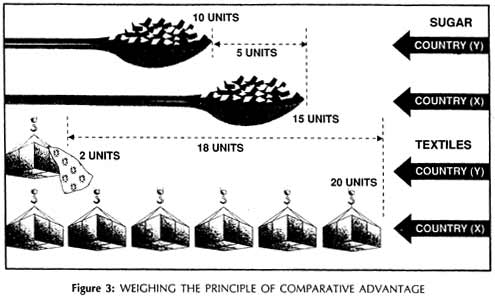
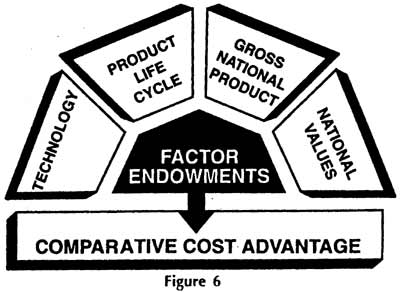
The Theory of Comparative Cost Advantage Our world is a diverse one: nations vary on several counts, starting with size and population, climate, language and currencies. Add to these differences in resource availability, in educational, technological and income levels, variations in trade and investment regulations and in tax laws, and there emerges the ideal climate for trade and investment opportunities both on the part of business firms and amongst governments. While it is an extension of domestic trade, global trade springs largely from the existence of comparative cost advantages. The theory of comparative cost advantage was first stated in 1917 by David Ricardo in his book Principles of Political Economy and Taxation, and was simply illustrated by an example of the times. Portugal and England, explained Ricardo, traded in wine and cloth. This was despite the fact that in absolute terms, Portugal had the greater advantage in production of both commodities. In relative terms, however, there was a higher advantage to Portugal in terms of wine production, and so Portugal exported wine to England, while importing English cloth. Again, take two men who both make hats and shoes, as Ricardo did. One of the men is actually better than the other on both counts, with his advantage on the hat front resting at 40 per cent, while in the business of making shoes he is 33 per cent more productive. It would therefore be better, in terms of the principle of comparative cost advantage, for the better man to concentrate on the making of hats, leaving the making of shoes to the other. Thus in global trade, basic economic forces work towards outflows from each country in those areas where in relative terms its resources are greater. Global trade covers the transfer of resources in the fields of capital, labour, technology, management and know-how, and in the areas of natural resources and finished products, from one nation to the other, based on factor endowment and on applicable government regulations. Let us assume that for a given expenditure of 10 dollars in resources (land, labour and capital), the countries X and Y can produce textiles or sugar in the proportions shown in Figure 3. One might conclude that X should produce both since it is more efficient in the production of both commodities, and that Y would be better off if it imported both products and invested its 10 dollars elsewhere. But a second look at the above figures indicates that this is not the case. Gain from trade is in fact possible for both countries. While X is more efficient in an absolute sense in the production of both commodities, its comparative advantage is greater in the production of textiles. X is 10 times as efficient as Y in the production of textiles, but only 50-per cent more efficient in the production of sugar. If there was some way X could get more than 15 units of sugar (the amount it produces itself) by giving 20 units of textiles, it would be worthwhile for it to produce only textiles for export to Y in return for sugar. If X decided to shift the 10 dollars expenditure in resources from textiles to sugar, it would give up 20 units of textiles domestically and get 15 units of sugar.
As far as Y is concerned, if it could acquire more than two units of textiles by giving up 10 units of sugar, it would pay to concentrate on the production of sugar and the import of textiles. Y then is comparatively most efficient in the production of sugar. In other words, its comparative disadvantage is lower if it produces sugar rather than textiles. Let us assume that Y exports three units of sugar to X for two of textiles. Y would be better off by the trade because it would receive two of textiles and would have to give in exchange only three of sugar. Y is definitely much better off exporting three of sugar for two of textiles because domestically it would, for the same expenditure in resources (10 dollars), have to give up 10 units of sugar to produce two of textiles. The gain from specialisation and trade is the same, whether or not the trading areas are separated by a national border. Thus, in the above example, the principle of comparative advantage would apply equally if we were to substitute two local regions in the same country and any two products for textiles and sugar. For example, the automobile industry in the USA was initially concentrated in Detroit, but as demand increased throughout the country, it became necessary to establish economies in operation, and the business spread, with investments being made in new geographical areas. The US rubber tyre industry also developed in a similar manner, moving to several locations from its initial base in Ohio. Trade between regions takes place because of differences in production costs. It is these differences in production costs that make it economically feasible for trade to take place between geographical areas. Nations build barriers such as tariff protection laws, quotas and taxes that then act as accelerators or impediments to inter-nation trade. States within countries do the same, and it is this which tends to be taken into account in deciding which product is best produced in each region or country. Factor Endowment and Trade Comparative cost advantages exist, according to Heckscher and Ohiin, because of differentials in factor cost from one country to another. This in turn, depends on the differentials existent in factor endowment. Thus, Australia which has more land has a higher potential for agro-based products than a smaller country such as Japan, since land is a major factor in agricultural production. Cheaper and more abundant labour available in developing countries contributes to a comparative cost advantage in those production processes where labour is relatively speaking, a large input. The larger the relative Input of the less expensive and more plentiful factor in the manufacture of a product, the greater is the export potential of those products from that particular country. The Leontief Paradox raises some doubts on the universal validity of this assumption. At times a country with high capital abundance may not follow trade patterns in keeping with its factor endowment, and may in fact export products that are traditionally more labour-intensive. In Holland for example, the cultivation of certain kind of fruits, flowers, and vegetables in state-of-the-art greenhouses has developed on account of major investments in this area. Thus the availability of abundant capital has resulted in Holland, despite its limited abundance of land and labour, becoming a major exporter of these products. Technology and Trade The factor proportion may in fact vary from one country to another for the manufacture of the same product, as borne out by Gruber, Mehta and Vernon's research. This-brings into play another variable-technology, with different levels of technological input influencing the proportions of the other factors required.
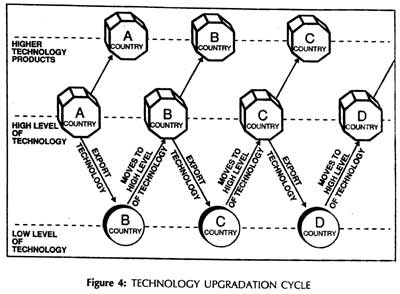
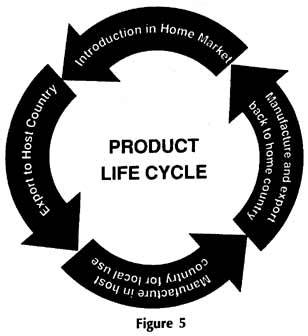
Thus, in the glass container manufacturing industry for instance, the higher the level of technology, with increased automation, the lower the manpower required, not only during the process of manufacture, but even say, at the packing stage. This is also true of a large number of process industries, chemical, pharmaceutical and even textiles. Application of technology also makes for a ladder of development of higher productivity. As a high technology country exports its technology to a low level technology country, the latter country masters the technology that it imports, moving to a higher level of technology itself, and in time, becoming an exporter of the same technology. The country hitherto at the high technology level then has to develop products/technologies which countries at a low technology level need to develop further. Thus, synthetic textiles were first manufactured in Japan and the USA and exported from there all over the world. In time, textile technology evolved and was transferred from the USA and Japan to developing countries, typified at that stage by Korea and Taiwan. In the process, these countries moved from a low level of technology to a higher level by importing and assimilating textile manufacturing capabilities, eventually reaching the point when they exported this technology themselves, in this case, with export related to plant and machinery to developing countries in Asia and Africa. Meanwhile, textile manufacture in Japan and the USA increasingly focused on speciality products, and the basic range of textiles is imported into these countries-from the developing world. GNP and Trade Trade between nations is dependent on GNP levels, according to Linder, with higher per capita incomes increasing the potential for mutually beneficial trade, and vice versa. Thus the higher GNP of both Germany and Switzerland makes for greater trade between these nations. India and Bangladesh, on the other hand, with their low GNP, have low levels of trade between them. Further, states Linder, varying per capita incomes ensure the production of different products, because of different needs and different factor inputs. For example, there is considerable production in the field of entertainment electronic's in Germany and Switzerland, while these items are produced in proportionately much lower volumes in India and Bangladesh despite their larger populations. Product Life Cycle and Trade The concept of a "product life cycle" in global trade, introduced by Wells, Hufbauer and Hirsch has also been detailed by Raymond Vernon in his "product cycle theory." According to this concept, four stages exist in the life cycle of a product in global trade. Stage one is the creation of a product with a unique characteristic, particularly in high per capita income economies. In the synthetic textile industry, this stage was marked by mass production in the USA and Japan. The second stage comes when the product is exported to countries where demand has been created by awareness of the product and its utility. This stage is also marked by satisfaction with the product in the country of origin. Stage three is when the product is manufactured in the countries that hitherto imported it, taking advantage of factors such as lower labour costs. At this stage the product is made only for local/regional consumption, with demand being high enough here to sustain production. In textiles, manufacture commenced for domestic consumption in the developing countries themselves, as labour costs escalated in the USA and Japan. The fourth and last stage comes when the initially importing country exports the very same product at a lower cost to the country of origin, which by now has ceased production. Global Corporations and Trade Extensive research in theoretical structures for the understanding of trade theories and the role of global corporations in the area of resource transmission has been undertaken by Professor John Fayeweather. The highlights of the research findings include:
Professor Fayerweather's research therefore comprehensively reviews trade and business flows and the role of global corporations, developing the principles of global trade beyond the basic theory of comparative cost advantages. National Values and Trade Countries like Japan, South Korea and Singapore are vivid examples of how a combination of appropriate values (in .the areas of infrastructure, R & D and taxation for instance) and relevant government policies can overcome poor factor endowments to make them globally competitive, thereby raising the economic well being of their people.
|