|
 |
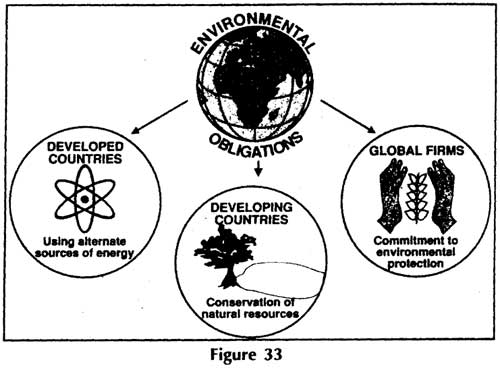
Environmental Protection : Some Suggestions from the UN The World Development Report 1992 of the United Nations has made some useful suggestions which are still valid today guiding action for national policy makers in the area of environmental protection. Build the environment into policy making Make population a priority Act first on local damage Economize on administrative capacity Assess and minimize tradeoffs Research, inform, train Prevention is cheaper than cure Adjust aid portfolios Invest in research and technological development Ensure open trade and investment Pay for environmental services Developed and Developing Countries and Environmental Protection Environmental protection is a key aspect of economic development and the economic progress of nations will be undermined without adequate environmental protection in the future. Thus both developing and developed countries need to play their respective roles in ensuring adequate environmental protection. The role of developed countries: Developed countries should provide access to less polluting technology and share environmental lessons learnt. Funds could be created to be used for research to conservation of natural resources and or developing alternate sources of energy. Developed countries can provide their developing counterparts better access to markets, thus facilitating the laters growth and reducing the pressure put on depleting natural resources. The role of developing countries: Developing countries on the other hand, could enforce the most stringent laws for industries that use excessive fossil fuel, irrigated water and pesticides, and industries that deplete natural resources and cause environmental pollution. The governments of developing countries should structure their laws on ownership and management of land, forests and fisheries so as to minimize depletion and damage. Both developed and developing countries should have clear- cut long-term laws and practices so that firms developing business can be sure of what to expect for now and in the future. If this is done, environmental disasters such as the one at the Union Carbide plant in Bhopal, India need never occur. Global Business and Environmental Protection Underwriter Laboratories (UL) Inc. probably the longest safety certification agency in the US (where testing for safety is a multi- million dollar business) has made the environment the company's concerns. The range of thousands of millions products in the US that carry the UL trademark of approval now includes toilet paper brands tested for being biodegradable and otherwise environmentally sound. G. Thomas Castino, president and chief executive, UL, puts this new development in perspective when he states, "The planet is starting to tell us it can't take it anymore." Global business firms, in order to make their due contribution to the environmental protection of planet earth, need to follow a certain system of values and principles in respect of environmental protection. Suggestions include:
The WORLD WATCH Institute, a Washington-based think tank, has called for the introduction of "environmental taxation" to protect the environment from damage caused by the growth in international trade. Such a step will internationalize environmental costs and place world trade on a more sustainable footing, according to a new study titled "Costly Trade-Offs: Reconciling Trade and the Environment." The study documents a growing number of short-term clashes between protecting the environment and promoting free trade and rejects the view that these aims are incompatible. The interests of trade and environmental protection ultimately coincide, it adds. World merchandise trade totaled US$3.5 trillion in 1991, nearly a fifth of the world output. It has grown eleven-fold since 1950, while economic output rose five-fold over the same period. The study, therefore, says, "A 'green round' of the General Agreement on Tariffs and Trade (GATT) is a high priority", and the choice of strategy - environmental taxation, regulation or consumer pressure - will depend on what is being produced and where. Social Obligations of Global Firms Global firms have certain social obligations wherever they operate. They could, for example, initiate social responsibility in training workers from underprivileged groups, constructing and subsidizing housing providing school and medical facilities, providing training and infrastructural development projects, including agricultural projects, thus facilitating better socio-economic and political conditions. Activities in any area entailing a major change should be planned and should include all affected people in discussion particularly when a change in operations has a major effect on the lives of employees and communities, and on the environment. The global firm should ensure that a venture brings adequate socio-economic benefits to local society, and to people in the host country. It also must demonstrate Firm commitment to bettering the lot of the local population by being a visibly good citizen. BODY SHOP: ENVIRONMENTALLY FRIENDLY, SOCIALLY RESPONSIBLE Starting off as a small business in natural beauty products, Body Shop is today a mammoth franchise operation spanning the world. Its wide range of hair, skin and body care products continue to find their origins in natural sources, and in keeping with this, the company is committed to the preservation of natural resources, for example, the Brazilian rain forests. Body Shop extends this conservationist stance to its interfaces with consumers: packaging is always kept to a functional minimum, the use of plastic carrier bags is constantly minimized and refilling of bottles actively promoted. Body Shop's 'Trade not Aid' policy also reflects the company's philosophy on the socio-economic front. Economic support to developing countries (and in particular to development projects run by voluntary agencies) is extended through export orders for beauty care and health-related accessories.
|