
Evolution of Human Lifestyles
Looking back at how man has evolved from hunter gatherer vis-à-vis business and industry. We find the starting point in agricultural and animal-rearing communities, where lifestyles were rural and basic in nature. Simple manufacturing came next, for example spinning, as also weaving on very rudimentary hand looms, with a shift to semi-urban living. Urbanization followed in due course, and manufacturing grew more sophisticated. As life became more complex, new needs gave rise to the services sector, with financial services and transportation for instance fulfilling specific roles in the new society that developed. While urbanization continued to set the demographic direction, new trends emerged, where among the affluent even in developing countries, for example, having a second home located in the country became fairly common Now human development seems to be harking back to basics, but the new "going back to nature" vanguard, with a focus on the preservation of the environment. On the other hand, disparities between nations and within nations between the rich and the poor, have increased.
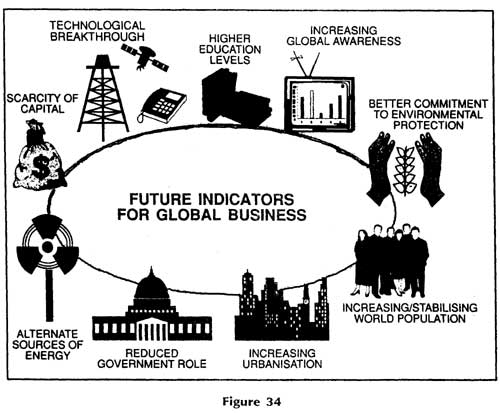
Future Indicators for Global Business
World Population
The future population growth of developing countries will continue to rise despite control measures. Thus, by the middle of the next century, more than 80 percent of the world's population will be concentrated in the developing world.
Education
Higher Levels of the literacy will be prevalent in most countries, with literacy at least up to the basic level by the middle of the next century.
Urbanization
This is another important aspect with regard to developing countries and those that have predominantly agrarian economies. There will be a large shift of these populations in the process of urbanization, and by the middle of the century, an average about 50 percent of the population will be found in urban areas. Secondary orbit cities may be the targets of such a shift in population, and not major metropolitan cities, on account of the difficulties associated with living here. However, urbanization as a whole would be a continuing trend in the century.
Global Awareness
With improved telecommunications and the advent of satellite TV, national controls on information are being eliminated. Happenings from all over the world are beamed into homes everywhere via international networks, revolutionizing people's levels of knowledge and awareness. As the world therefore shrinks into a global village, people's aspirations and demands will be further accelerated, exerting greater pressure on government and business to develop policies and products of global standards.
Capital
Developing countries will continue to be short of capital and the developed world will be comparatively better off. A shortage of capital will prevail however even in the developed world, especially in the new free market economies of the erstwhile communist states. However economic opportunities in the developing countries withdraw FDI for better returns on investment from sources in the developed world.
Energy
With fluctuating oil prices with upward pressures will provide incentive for development of alternative sources of energy which are likely to make breakthroughs. Although dependence oil is unlikely to decrease as the coming economic boom in developing countries will greatly increase demand for oil.
Technology
Technological change will be the hallmark of the next century as rapid developments continue in the field of electronics, micro electronics, hydro phonics, lasers, computers, genetics, bio-technologies etc. Integration of the computer, the television and telecommunications coming together, into one "multi purpose hand held, wireless, electronic unit to meet that needs of education entertainment and communications". Companies that create technological breakthroughs in the field of agriculture and agro-industries will be major galners in the future world with increased population pressures, as will be countries and firms spending more on R & D and technology in general.
Regionalism
With the end of the Cold War, military objectives will be based more on local, ethnic and regional requirements as opposed to global geological objectives. Thus more regional groupings will emerge and with be based on local security requirements and ethnic considerations. The clash of civilizations will be accentuated.
Government role
Governments will be proactive, catalyzing the political and economic development process as the globalisation wave spreads. More and more countries will shed their 'isolationist' policies and fall into the global economic system & make more & bolder moves for openness of the economy.
Trade barriers/Trading blocks
For the next few decades large trading blocs will be here to stay, developing strength as individual trading barriers between countries fall. Countries will be forced to continue to improve productivity and to introduce enlightened legislation as a means of domestic competitiveness. It is hoped that by the middle of the next century the trading blocs themselves will fade away into more open global trade, with the world operating more as a truly global village.
Free market economies
The process of the development of free market economies will be accelerated and it will be this approach to economic development which will determine the future of the world's economic systems. Large economic blocs such as China and India have already stated to develop more rapidly with free market economies.
Global telelinks
International communication networks based on computers, modems and telelinks, which will get increasingly sophisticated, will considerably facilitate communications, thus accelerating the process of the creation of a global village. Services sector
The continued increase in the importance of service sectors in both developed and developing countries globally will be another hallmark of the change in economic development and business direction.
East-West conflict
The conflict between developed and developing countries on intellectual property rights and counter claims on the developed countries for access to their markets would continue to be accentuated in the decades to come, resulting in a major area of economic conflict between the two groups of countries, with both sides negotiating as hard as possible. The conclusion of GATT is an important indication of the shape of things to come in this area.
Home countries faced with shortage of foreign capital and foreign exchange would increasingly exert pressure on foreign investment, foreign exchange earnings and export-oriented industries. There may therefore be restrictions on firms making direct foreign investment unless this is offset by inward returns.
Environmental protection
The environmental protection groups will increase their importance and influence in pressurizing both developed and developing countries for better environmental protection.
With
increased consciousness towards environmental protection, related
measures will be accelerated, with greater cooperation between developed
and developing countries, all doing their bit for environmental
protection in spite of the conflicts and differences that exist.
With a view to protecting planet earth, it is expected that if not
better sense and voluntary and legislative measures consumer drive
will greatly increase to pressurize firms to adopt eco-friendly
practices. Thus firms in the environmental protection areas of business
and those which follow environmentally friendly practices will flourish.
|


