|
 |
|
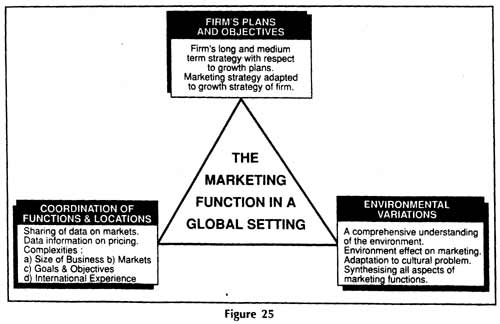
Marketing in the Global Context Marketing is a key business function which entails the identification of people's needs and wants, and with the assistance of to her departments of a company, entails the fulfillment of these needs to the benefit of both the person receiving the product or service, and the organisation producing it. Seen in a global context, while the objectives and methods of the marketing process remain the same, as does the marketing function, the difference is that international marketing activities are conducted across national boundaries and simultaneously in a number of different national markets. These markets differ widely from country to country, reflecting cultural and social variations. Moreover, many governments with varied national interests shape the environment in which global marketing operates. These international elements affect both marketing strategy decisions and marketing management. At the strategy level, the global setting makes the product mix decision substantially more complex, and at the marketing management level, the global setting impounds the task of adjusting the individual elements of the product mix to the needs of the identified markets. Contemporary global corporations have to serve the needs of varying customer segments, sometimes coming up with new products and services that headquarters never would have thought of. In Japan for example, Mr Donut's changed everything about its product/service, except for the logo. Evolution of Global Marketing The concept of the international product life cycle often forms basis of the decision for companies to go international. Foreign markets offer manufacturers an opportunity to extend their products life cycle after the point of saturation for domestic demand has been reached. Thereafter, the same products may be made globally been at less cost, and enter the domestic market in competition with domestic firms, thus moving in the process from the new product stage to a mature product to a standardised product. The usual way to enter a foreign market is export, which may well be occasional or passive in nature, or more active in approach. Companies typically start with indirect export through links with agents or export management firms, eventually moving on handling their own exports, with increased levels of investment handling their own exports, with increased levels of investment and risk, but greater potential return. Licensing is yet another mode of entry into the international marketing arena, as is contract manufacturing, or in the area services, management contracting. Joint ventures and direct foreign investment are other entry options, and while most companies show a distinct preference for one mode of entry environmental factors such as the global legal framework mean that companies must optimally adapt to varying situations, thus learning and mastering alt entry methods, and finally going through the internationalisation process. The Global Marketing Programme Should a company operating in several markets adapt its marketing mix to varying local conditions? If so, to what degree? And if no is a standard marketing mix worldwide a viable one? The question of international standardisation versus differentiation is one that impinges upon all areas of the marketing mix, and potential adaptations therefore touch all its elements: product, promotion, price and distribution. Product Strategies Product strategies may involve straight extension, or the introduction, of a product into international markets with no change. Such strategies have been extremely successful with cameras and consumer electronics, and equally disastrous say in the case Hallmark cards in France, where people prefer writing their own messages rather than sending sentimental ones of the printed kind. Product adaptation, on the other hand, allows for local condition and preferences. Thus General Foods blends different coffees for the British, who add milk, the French, who prefer to drink it black, and for Latin Americans, who want a chicory taste. Product invention is another strategy available, and consists of creating something new, either the reintroduction of earlier home market product forms that may be well adapted to the needs of a particular foreign market, or the development of a brand new product. These considerations result in a choice of product strategies including: One product, one message: This is the simplest and most profitable strategy, and is used successfully, for example by international cosmetic firms, which sell the same product worldwide, using central advertising and promotional appeals, in the face of little variation from country to country in terms target customer groups, product usage patterns and consumer attitudes. Product extension - Communications adaptation: Bicycles, for example, satisfy mainly recreational needs in the west, while providing a means of transportation in developing countries. In such a case, therefore, slight adjustments are to be made in the marketing mix, with the only additional costs in identifying different product functions and in reformulating advertising, sales promotion and other communications accordingly. Product adaptation - Communications extension: Here, the central communications strategy is extended without change, but the product undergoes adaptation to varying use conditions in different countries. Thus, while Esso did "put a tiger in your tank" worldwide, the physical characteristics of the gasoline was adapted to climatic and user conditions as necessary. Dual adaptation: A combination of the last two strategies described above is used in this approach, when there are difference in both the environmental conditions of use and in the function that a product serves. US greeting card companies have faced these circumstances in Europe, where the occasions to send card vary, and where, as mentioned earlier, senders prefer personalised messages, necessitating the provision of a blank space in the card. Product invention: If product development costs are not excessive this may be a potentially rewarding strategy, particularly for mass markets in developing countries. Thus both Ford and General Motors developed entirely new motor vehicles that are small inexpensive, easily assembled and designed with emphasis on utility and durability. The best product strategy - the one that optimises profits over the long term - will depend on the specific product- market -company mix. Some products demand adaptation, others lend themselves to this process, yet others are best left as they are. The same is true of markets, and it is thus, only after analysing the product-market fit, the company's capabilities, and the costs involved, can the most profitable international product strategy be chosen. Pricing Strategies In the area of a global pricing policy, several choices are also available to firms, once more within the spectrum of international standardisation versus differentiation. One is uniform pricing, whereby a Coke may simultaneously be cheap in the USA and beyond the reach of many, say in China. A market based price in each country is another pricing option, but the disadvantage of ignoring varying actual costs is inherent here. Using a standard mark up is yet another pricing strategy, where a varying cost- based price is used. In setting prices for any single market, both cost and market conditions are important. Costs set the price floor, as it were, and competitive prices for comparable products set the price ceiling. Between the floor and the ceiling, there is an optimum price which is a function of the demand for the product and the cost of the product. The international company that uses pricing as a part of its strategic product mix will develop a pricing system and pricing policies that recognise the diversity of national markets in these three basic dimensions viz. cost, competition and demand. In addition of course, pricing policies will have to be in keeping with a number of international constraints such as WTO regulations, tax policies, dumping legislation and governmental price controls as and where they exist. Transfer pricing i.e. prices for goods and services exchanged within the international corporate family is another area to be considered here, with adjustments appropriately made resulting in the advancement of company goals and in the increase of overall profits. Promotional Strategies Promotional strategies may also be adopted as in the home market or adapted to each local market. The same message may be use around the world, with changes made in terms only of language name and colours, or the same theme may be used with necessary adaptations suitable to the values of each local market, or finally a complete adaptation may be made for the local market, including the changing of the theme. Media used will go through the process of local adaptation based on varying availability and effectiveness. Promotional strategy will depend of course on product strategy. When a product fits a different need or services a different function in a market other than the home market, adjustments are required in promotional direction. Particularly relevant in this context is a product such as the Sony Walkman. Listening to music en route to work without disturbing fellow commuters was the prime consideration when Sony's Chairman Akio Morita first conceived the product. While the Walkman proved extremely popular in the USA, the reason for its success was completely different: it cuts off disturbance from the outside world for the listener. Adaptation of promotional strategy is also called for when promoting new products designed specifically for a particular market. In terms of advertising, culture-specific campaigns will no doubt be more effective than those that are more central in nature, given that cultural and socio-economic environmental differences play an important part in shaping the demand for specific types of goods and services and in determining what kind of promotional appeals are best. Thus the appeals, visuals and other advertising features used must differ from market to market. But this may be only a matter of changing specific advertising messages, and not the basic approach. The use of symbols is important here, as is colour. Thus Esso's tiger, in a country like Thailand, where the tiger is not a symbol of strength, was not understood. Similarly, the colour yellow has always been the imperial colour of China, and is not used extensively except for religious purposes. The principles underlying promotional communications are in short, the same worldwide. It is only the specific methods, techniques and symbols, as well as media, that sometimes need variation. Uniformity has tremendous economic advantages and the critical questions for a global company is when to and when not to make adjustments. The best strategy, therefore, is to try and take into account the international differences when preparing a promotional strategy, and to export the same approach to as any markets as possible, while allowing for inputs from people who have knowledge of various foreign markets. Distribution Strategies Distribution channels vary widely from country to country, particularly with respect to the number and types of middlemen involved in the distribution process, and in the size and character of retail units. Japan, for example, has the most complicated distribution system in the world, marked by several layers both at the wholesale and retail levels. However, as Kenichi Ohmae points out in The Borderless World, Coke has 70 per cent of the Japanese market for soft drinks "because Coke took the time and made the investments to build up a full range of local functional strengths, particularly in its route sales force and franchised vending machines. It is, after all, the Coke van or truck that replaces empty bottles, not the trucks of independent wholesalers or distributors." International distribution management is closely related to several dimensions of marketing management and global strategy. lf entry to a new foreign market is through licensing, the development and managing of distribution is the responsibility of the licensee, joint venture is to be put into operation, distribution management is another question altogether. No matter what the initial entry strategy, however, distribution choices must been valuated against the long range goals of a company in a specific market. As a first step to identifying distribution channels, their desired function should be spelt out. In the case of automobile exports for example, a necessary distribution function must be the provisional of after sales service and repairs. The next step is to understanding the distribution alternatives available, and given that the structure of the distribution system is in the process of change in many areas of the world, the formulation of a distribution strategy and the selection of appropriate channels must take into account this process of change. Within this framework, then, international distribution management requires the design of a structure distribution units that will perform the physical distribution task provide service and other necessary functions and form an effective transmission system for feeding back market information to company. Standardization versus Differentiation The advantages of product differentiation to meet the needs of varying markets are in direct conflict with the advantage of reducing unit costs through standardization. Standardization can bring considerable savings from production economies, and from spreading expenditures on R & D, advertising, promotion and general management over a greatly expanded sales base. Yet pressures toward differentiation are great. The marketing strategy of global firms therefore generally falls somewhere between the extremes of a central market focus a decentralised development, and between the extremes of product mix standardisation and diversification. Aircraft adaptation Aircraft manufacturers have excelled at producing globally standardized products, while being flexible in meeting differing worldwide needs by adapting the standardized core product. When in the early 70s Boeing found sales of its 737 model beginning to level off, it turned to the third world as an attractive new market. The product Boeing had to offer, however, did not fit the new requirements and Boeing found that due to the shortness of third world runways, their comparative softness, and the lesser technical expertise of third world pilots, its planes tended to bounce a great deal. And when the planes bounced on landing, the brakes tended to fail. Boeing therefore modified the design of the 737 by adding thrust to the engines, redesigning the wings and landing gear, and installing tyres of lower pressure. These adaptations to the standardized core product enabled the 737 to become one of the best selling planes in history. In the area of services, McDonald's stays close to its core formula in terms of restaurant layout and design, its service approach and the key components of its menu, but permits a degree of differentiation on grounds of national variations, for example, adding on the serving of alcohol in France. Coke in Japan - an Example of 'Insiderisation' As Kenichi Ohmae elaborates on the subject in The Borderless World, when discussing the entry of Coke into the Japanese market, access to this market was by no means assured from day one, consumer preference was not assured from day one. In Japan, the long established preference was for carbonated lemon drinks known as saida. consumer demand did not pull Coke into these markets, the company had to establish the infrastructure to push it. Today because the company has done its homework and done it well, Coke is a universally desired brand. But it got there by a different outer: local replication of an entire business system in every important market over a long period of time Coke redefined the domestic game in Japan - and it did so not from a distance, but with a deliberate 'insiderisation'. Appropriate Adaptation - A Key to Effective Global Marketing Since the market environment in different locations is varied, one of the first tasks of the global marketer is to have a comprehensive understanding of the environment indifferent locations in which the marketing function is to take place. The environmental effect on every aspect of the marketing function needs to be looked at and analysed. McDonald's and Coke appear to integrate people globally. However, they symbolize quite different things in different countries. For instance, a hamburger is not affordable by everyone in Moscow and hence is a show of status and affluence, whereas in the US it represents a fast-food, which is by implication cheap. Such a marketer must be able to adapt to the cultural variations and synthesise all aspects of the marketing function and adapting this for the operation of a successful business. Since each nation has its own value systems and beliefs, the global marketing manager must try to understand these practices and test if widely known hypotheses are true. For example, it is said that Frenchmen use far more toiletries than their female counterparts, that spaghetti, though traditionally an Italian food, is eaten more in the branded form by the Germans and the French, that women in some parts of Africa avoid milk and eggs as they fear these foods cause impotency and baldness. Thus it is very important to test widely believed hypotheses before venturing out with a marketing strategy in an alien setting. The advent of effective globalisation in the foods, electronics, automobiles sectors has been phenomenal. This effectiveness has not only been in European and US companies but also Japanese, Korean and now, Taiwanese companies. The companies that a now household names worldwide, are Sony, Honda, Nestle Mercedes, etc., and even in the USA, there are products that see to be domestic but actually are global products of other nation such as Baskin Robbins ice cream, Lipton tea, etc. Also with huge investments by Arabs and Japanese firms in the USA, there a many global firms operating. Similarly several American companies have set up global businesses including McDonald's, Ford, IBM, Boeing, Xerox, etc.
Proliferation of global markets takes place very rapidly today compared to the past. For instance, the VCR market may have first emerged in the triad regions of Japan, Europe and the USA, but VCRs have rapidly proliferated worldwide. Similarly other products such as those from Siemens and ITT, the Mercedes Benz range or automobiles and ahost of Japanese cars are now found in continents as far apart as Latin America, Australia and Asia, besides the developed countries of Europe and the USA. SKF, a Swedish firm, a large manufacturer of ball bearings, set up a South East Asia sales and distribution centre in Singapore. Singapore provides excellent shipping, air freight and free port facilities without the hassles of tariff, etc. In addition to this, SKF subsequently added a manufacturing facility in Singapore, the output of which is sold worldwide through the coordination of the SKF German subsidiary. Thus, centralised control of exports is one way to achieve international logistics coordination. Similarly, Eaton produces in 43 countries besides the USA, and all its products are exported to more than 100 countries through its worldwide marketing organisation based in Switzerland. However, there are certain complications in the process of adaptation versus standardisation and some countries run into various difficulties, specially in the consumer product field, in determining the extent of adaptation and guarding against over adaptation. For example, Gillette sells about 800 products in about 200 countries and uses different brand names for identical products. Thus Gillette's Silkence Shampoo is called Soyance in France, Siental in Italy, and Silience in Germany, with advertising messages also varying from country to country. Gillette are at times unable to determine whether the adaptation is excessive or appropriate. Thus, it is important to adapt but it is also necessary to guard against over- adaptation. EURO-DISNEY: TRANSATLANTIC TROUBLES The initial enthusiasm that greeted Disney's multi-billion dollar plan to bring a theme park to Europe soon turned to scepticism, the Euro-Disney dream was soon a nightmare. This despite the fact that Disney films and cartoons are more popular in Europe than in the US, with the largest market in fact being France; that preliminary market studies suggested that as much as two-thirds of the French market would like to visit the theme park; that Tokyo Disney, the company's first foreign venture has been a great success. And after all McDonald's had made it in the very heart of gourmet Europe - Paris. Euro-Disney also came backed with massive investment, strong government backing, a lack of direct competition and a well tried and tested amusement park formula. Yet in the very first year, Euro-Disney attracted far fewer visitors than predicted, and became the target for much public criticism. Plans for making money from land development were also hit by a slump in the property market and by high French interest rates. Euro-Disney was designed as an exact copy of its American forerunners - simply moving American culture to Europe. But a theme park is not like the movies and comics that Disney so effortlessly exported, the experience involved is not vicarious but interactive, engaging the consumer in a hands-on experience in a way that actually makes the show work. "Having a nice day" in the American sense is what Disney parks are all about, an approach that is high on smiles and togetherness, family and fun, in a way that is instantly accepted in the US. It is also a highly intensive, driven, unrelaxing, unrelenting experience. Disney music follows the visitor into the public toilets each hotel room is dripping with Disney memorabilia, and the television is overloaded with Disney channels. This is vastly different from the relaxed German concept of gemutlichkeit and other continental European equivalents. Thus merely re-creating American fun in Europe is not relevant to the European consumer. Disney has also always emphasised its wholesome, clean, safe environment. What is spotlessly "clean" for the American however may be "sterile" for the Latin European. If "safe" means walkie-talkies all over the place, this could well appear menacing to the average European, and "wholesome" translating in the American sense to an alcohol-free environment is almost ridiculous in wine-drinking France. The most serious flaw in Disney's European strategy is the failure to recognise that its formula for marketing success is culturally dependent and re-thinking how Americana plays in Europe is now a very serious consideration that Disney is making. |