|
 |
|
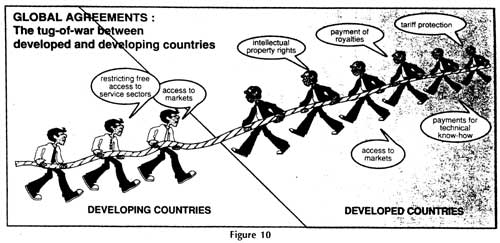
The Need for Global Agreements Governments have established regulatory frameworks with the aim of protecting or developing their countries' economies or increasing their share of the benefits associated with the activities of transnational corporations. These influence the flow of capital and technology. There is a constantly evolutionary state in the life of a nation that causes it to change its regulatory framework depending on its needs at a particular time. Countries are constantly evolving their policies to suit and adapt to such changes. Thus China, under the communist model for economic development, closed its doors for (over two decades, concentrating on providing its population with) the basic needs. Today, the Chinese economy is far more open, inviting as it does foreign technology and investment. Brazil is another case in point, where a relatively recent free market economy has accelerated economic development. Similarly, India, which followed a socialistic pattern of economic development has liberalised its policies, opting for market reform. There is also a conflict of objectives and approaches to global trade depending upon the status of the nation, whether it is a developed country, a developing country, a newly developed country or even a centrally planned economy, few of which continue to exist in the world. The developed countries lay a great deal of emphasis on freedom of access to markets of all countries of the world for service sectors, viz. banking, insurance, shipping, etc. They also seek to ensure proprietary advantages such as intellectual properties and the payments for patents and royalties for R & D investments made by them. Developing countries, on the other hand, favour relationships that permit the free flow of cheap manufactured goods to developed countries without the restriction of tariff protections. Developing countries also seek to protect their own markets, not permitting the payment of large royalties against intellectual properties. Such countries also restrict access to the services sector of developed countries. In some countries, the domination of the foreign business sector by firms of a particular nationality lead to stronger domestic controls. One way out is for global enterprises to acquire multiple nationality or to undertake projects with firms of other nations. Both Royal Dutch/Shell and Unlived have carefully nurtured their dual Dutch-British nationality as they have found the ambiguity to be a useful one. When Indonesia's President Sukamp was unfriendly to the Dutch, these enterprises stressed their British identity. When the British are on the firing line, it is the Dutch identity that is emphasised. IBM and Coke, on the other hand, left India when restrictions were put on the extent of equity they could hold and when they had to transfer all patents and know-how to the local subsidiary. Conversely, Mexico has developed extensive legislation, laws and incentives to promote investments, as have other countries such as Thailand, Singapore and Indonesia. As soon as a nation's level of control is raised above those of alternative locations, that country becomes a less likely location for further investment or expansion by international firms. When a country instead reduces its control levels, as did France after General Motors built a major plant wi Antwerp, Belgium, rather than in Strasbourg, France, a country is more timely to receive future investment. Regulations also develop around rules of competition like collusion, discrimination against certain buyers, promotional methods, variable pricing and exclusive territory agreements. Different nations also have laws on retail price maintenance, caned lotion of distributor or wholesale agreements, on packaging quality, warranty and after sales service, price controls, limitations on mark-ups or downs and patent, trade-mark and copyright laws and practices. Trade is also regulated by restrictive measures such as exchange control regulations, the imposition of non-tariff barriers such as setting certain discriminating standards, and features that would make it difficult for certain companies or ventures to be successful. The Dutch government, for example, bans tractors whose speed exceeds 10 miles per hour, rendering imports from the USA difficult. An embargo is the ultimate form of quota/restriction of trade in the imports of a particular category from a particular country Trade embargoes have existed between the USA and the foirne communist countries, between African nations and South Africa and also between the Arab world and Israel. Thus, on account of a conflict of objectives, most nations have found it prudent to enter into agreements to regulate global trade and business activity. Since global trade is encouraged by most nations, they have cooperated in constructing an international framework that help transfer goods and services across borders while still allowing for the imposition of restrictions and controls by their respective governments. While various common agreements exist, the development of a globally uniform regulatory framework has been a slow process owing to differences in levels of development, ideologies and perceptions of the priority of different issues by different nations. Further, there is generally a long delay between the time when the need for an agreement is identified and when the agreement is finally negotiated globally. General Agreement on Tariffs and Trade (GATT) The General Agreement on Tariffs and Trade (GATT), run by a small secretariat with a staff of about 400, has been the kingpin of tariff-cutting and world trade expansion since 1948. The General Agreement is a 'contract' calling for non- discriminatory treatment of trading partners and setting rules intended to counter protectionism and the law of the jungle' in international trade. The contract is what was left of the 1947 Havana Charter, drawn up as the constitution of a planned International Trade Organisation (ITO). ITO was intended as a mainstay of the post- war economic system on par with the International Monetary Fund and the World Bank. But a handful' of countries, including the United States, did not sign its charter. A total of 117 countries at present subscribe to CATT, which has organised eight rounds of negotiations to free intimation trade. The eight rounds have been :
Initially, a Trade Negotiations Committee was set up to monitor the overall negotiation and a group for negotiations on goods was established to oversee 14 areas, with individual cells for each one of the areas. The second part of the negotiations covered only one area - services. At the conclusion of a ministerial meeting in Brussels in December 1990, an impasse was reached and negotiations were suspended, resuming only in February 1991. The original 14 areas were then reshuffled into seven areas - agriculture, textiles and clothing, services, rule making, TRIMS and TRIPS, dispute settlement and Final Act and Market Access. The impasse came to be mainly because of the conflict between the USA and the European Economic Community (EEC) on the reduction of agricultural subsidies and the removal of import barriers. When the Uruguay Round concluded in Geneva at the end of 1993, all 117 participants in the trade talks agreed upon a text of about 500 pages containing 40 separate agreements. The main trading powers had showed their involvement in GATT, but from another standpoint many delegates viewed with distaste the dominance of the US and the European Union in the last part of the Round. Under the terms of the Uruguay Round, farm trade, textiles and services have been brought under GATT discipline for the first time. Although liberalisation in these areas will not be as thorough or as swift as exporters would have liked, the round has introduced significant new market opening rules. Thus all trade barriers in farming are to be converted into transparent tariffs', and the overall cut in tariffs is around 40 per cent, better than the one-third originally targeted. Trade in intellectual property is also for the first time being partly covered by GATT in this round which provides for the payment of royalties, and strengthens the" security of patents, trademarks and copyrights. In "this area~there is the fear that given the fact that these are held mainly by developed countries, developing countries will lose considerably in agreeing to make such payments. It must be noted, however, that never before has the third world played such a large role in reforming world trade as in this round. Developing countries have cut or frozen more tariffs than ever, and the talks have for the first time spanned areas of interest to the third world, viz. tropical goods, farm trade, textiles and clothing. It will take more than a decade before some of the Uruguay round's provisions come fully into force, and the round that took so long to be completed was out of date even as it was finished. The agenda for any future round will have to be even wider in scope - perhaps GATT (soon to be renamed the World Trade Organisation) will have to take into account such issues as social policies, workers' rights and minimum wages, even competition policy. There is also the fact that there remains scope for more liberalisation; tariffs in newly covered sectors are still too high. Also, major new economies, such as those of Russia and China will come into the GATT fold, and talks will need to begin once more. What the Uruguay Round will do for Consumers Tariffs. Tariffs in several areas have been eliminated completely Import duties on all household items will be reduced substantially over the years. Quotas. The quantitative restrictions which have damaged consumer interests will be removed over a period. Subsidies. These will be subject to a tighter discipline in industrial areas. Agriculture. Domestic support for farmers which encourages over production and export subsidies will be wound down over the years. Access to markets for agricultural goods will be improved. Textiles and Clothing. The Multifibre Arrangement will be Counterfeit products. The Uruguay Round includes the first multilateral agreement aimed at eradicating trade in counterfeit In general, the Uruguay Round will mean significant improvements in prices, choice and quality for consumer products across the board. Despite its drawbacks, GATT has proved itself the only worthwhile forum for multilateral discussions on questions of international trade. GATT is comprehensive and despite all the criticism against it, has very real achievements to its credit. International Air Transport Association (IATA) IATA-came into being in 1919 at the Hague between one Dutch, one German and three Scandinavian airlines. It was only in 1938 that Pan American and non-European airlines became involved. Regular conferences based on geographic zones are now held and rates and frequencies between global ports modulated. Rates are recommended by the conferences and the stability of air costs is largely due to conception of IATA. The United Nations Conference on Trade and Development (UNCTAD) There are several other conventions and conferences held to simplify and standardize trade globally. These include the United Nations Conference on Trade and Development (UNCTAD), held in 1964, during which the developing countries pressurized industrialised nations for preferences in exports. Several industrial countries have complied and several special agreements have also been developed to allocate production and markets to raise the export earnings of the developing world. Regional Economic and Trade Forums Nations in various regions have come together to form their own economic communities or groups for improved economic and trade integration within their regions. These include the European Economic Community (EEC), the European Free Trade Association (EFTA), the Latin American Free Trade
Global Legal Framework Global law until the end of the last century was perceived as the relationship between states and the limitation of their jurisdiction. Now the emphasis has begun to shift towards increased concern with the protection of fundamental human rights. The only international court is the International Court of Justice at The Hague and it is the principal judicial organ of the United Nations (UN). All members of the UN are parties to the statutes of this court. However, this court does not recognise individuals and corporations unless their case is put up by a member state. Also, the jurisdiction of the court only applies if both parties to the dispute belong to member states. This court has not remained very effective as a truly independent global court. Thus, the only avenues for justice for global joint ventures or multinationals are the multilateral treaties and conventions covering commercial and economic matters. However, since these are not fully adapted to meet the growing needs of transnationals, a beginning was made in 1975 by the UN, aiming to cover this segment by the establishment of the Economic and Social Council (ECOSOC), an intergovernmental commission on transnational corporations. This commission has representatives from 48 member countries and has advisory powers in connection with the full range of issues relating to transnational corporations, and the regulation and supervision of their activities. Protection of the Right to Establish Business Many governments, with the help of several treaties and Protection of Industrial Property Rights These include patents, trademark registrations, etc. Patents are granted and trademarks registered in the country of operation but are valid only within the territorial jurisdiction of that nation. To circumvent the problem of having to make several applications, the Convention of Paris executed in 1883 and periodically revised since then has established The International Bureau for Protection of Industrial Properties (BIRPI) which grants 12 months priority among its member nations to anyone applying for a patent in a member country. The EEC, along with Austria, Greece, Liechtenstein, Monaco, Norway, Sweden and Switzerland, went one step further by establishing a European Patent office, making one grant for all of its member nations.
Protection of Investment Since the UN International Court of Justice has no real powers to settle disputes, the World-Bank sponsored an intergovernmental agreement - The International (renter for Settlement of Investment Disputes (ICSID). Despite the large number of signatory nations, this forum is rarely used. The Latin American countries, in fact, refuse to be signatories to ICSID as they consider it an infringement of national sovereignty. Multilateral Investment Guarantee Agency (MIGA) is an affiliate of the World Bank and provides insurance on a non-cancellable basis for a 15-to-20 year period against civil disturbances and political risks in a member country. The investor has to pay a premium rate for insurance from MIGA, but MIGA considers itself more than just an insurance company. It examines and approves investment proposals, having first established government approval of the host country before proceeding with the insurance. MIGA insurance is not applicable on investments already in operation, but is considered in cases where investment is to be increased. Most countries of South Asia are already members of MIGA. There are several other treaties and conventions to protect global business but these are all subject to ratification by the host nation whose policies are the deciding factor. |