|
 |
|
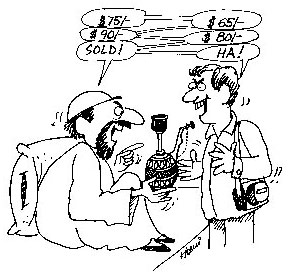
Shopping can run the gamut from simple purchases such as an often forgotten utility item like toothpaste to a focused hunt for ad particular kind of local art or craft. Hotel shopping complexes or the nearest shopping mall will answer the first need; the second will need some research both prior to, and on arrival. For more generalized shopping, it is best to check locally (or prior to departure with those in the know) as to where you may find good quality at the lowest price. Bargaining in a large, established shopping mall is out of the question, but bargaining in the market for high-value items is very much the norm, particularly in the shopping paradise of Dubai, Singapore, Hong Kong and Bangkok. Bargaining is also sometimes acceptable in owner managed outlets. Bargaining generally means getting a reduction in price of 5% to 10%, but this can go up to as much as 75% when shopping on the street in developing countries. Here, the vendor is out to make a quick buck and the foreign traveler is the most likely victim.
A friend once bought an expensive pen he had seen in a shop window. He requested that it be gift wrapped and gave it way only to discover much later, to his embarrassment, that he had been given a fake. The Shopkeeper had shrewdly assumed that since the pen was gift wrapped, his deception would not be discovered. The basic rule of bargain-hunting is to look around as much as possible, feigning disinterest and heading purposefully for the nearest exit. This almost invariably brings the price down. Hours of Business Shopping hours vary from place to place. In the Middle East, for example, businesses are generally closed in the afternoons. Shopping hours also vary from area to area in the same city. There may be extended shopping hours on certain days of the week, either in a particular area or sometimes even across a group of stores. In some places, all retain shops are closed on Sundays; elsewhere, it is possible to shop to your heart's content. Clothing and Shoe Sizes Where clothes and shoes are concerned, the multiplicity of sizing systems around the world can be confusing, especially to the uninitiated. However, companies are increasingly taking these variations into account and shopping for the right size is not so much of the problem it used to be. A ready checklist of the sizes you are shopping for makes the task even easier. The standard international size chart reproduced here will also help. COMPARATIVE CLOTHING / SHOE SIZES MEN
WOMEN
CHILDREN
Definitions of "small", "medium" and "large" are another matter altogether. A size "small" which is too large (bought in the United States) and a size "large" which is too small (bought in Taiwan) both hang in my wardrobe in testimony to the confusion. What is big in Asia is certainly not so in the West. This is compounded by further variables such as a similar collar size, but a different sleeve length. In such cases, it is recommended that you try the item on or at least take a long, hard look at it. In some parts of the world such as Africa, Asia and Latin America, measurements are generally based on one of the sizing systems represented in the preceding table. For instance, most countries belonging to the British Commonwealth follow the British system. Countries close to the United States follow the American system and countries that import from Europe follow the European system of sizing. |
||||||||||||||||||||||||||||||||||||||||||||||||||||||||||||||||||||||||||||||||||||||||||||||||||||||||||||||||||||||||||||||||||||||||||||||||||||||||||||||||||||||||||||||||||