|
 |
|
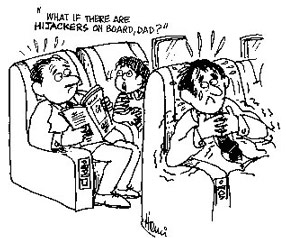
The traveler of the '90s has often heard the claim that one is statistically safer in an airplane than a car. In the subconscious mind of many people, however, there lurks the rationalization that while you can exercise much control over preventing a car accident (by your quick reflexes or reaction to a situation, for instance), you can do little in an airplane but sit helplessly at the mercy of unseen faces piloting it. The thought is unnerving, to say the least. To put this fear into perspective, think back to the statistics. Of 1.3 billion flights worldwide in 1993, only 33 involved fatal accidents resulting in a total of 1,020 airline deaths that year. Moreover, in the average air accident involving fatalities, more than half the people on board survive. Many of them are frequent flyers and people who have paid attention to safety procedures. Emergency procedures are designed to fulfill a specific purpose and even though you may doubt a seatbelt's efficiency in helping you survive a plane crash, it is wise to follow instructions. They mean a lot more than you might suspect. The statistics and averages of air-travel safety as cited above can, however, be misleading because situational differences affect your chances of being involved in an air accident. The airlines of North America, Southeast Asia, the Middle East and Western Europe are believed to be the most consistently safe in the world, in that order. Airlines in some other parts of Asia are a mixture of average, poor and good. South and Central America have the lowest safety score. This summarization is reflected in the amount that various airlines pay for the insurance of their aircraft. In general, the airlines of developing nations pay higher insurance premiums. Another factor that may influence safety records is whether a flight is domestic or international. Statistically speaking, international airlines have a better safety record than domestic airlines, probably because they use bigger, newer planes and have to adhere to international safety standards. Jets or planes that run on turboprop engines are fare more reliable than those that run on piston engines. The former have improved aviation safety records since the 1950s. Today, however, the focus is on decreasing accidents caused by human error, as such accidents are more common than technological or technical problems. In Britain, for instance, commercial pilots are required to take an examination in psychology, in addition to other qualifications, to obtain their licences. A domestic flight that my daughter took within the United States recently had to make an unexpected landing in Cincinnati's airport, from which it had taken off 20 minutes earlier. Something was wrong with one of the engines, the pilot explained calmly. Back on ground, technicians surveyed the aircraft and decided to cancel the flight. There is also the fear of premeditated hazards. While hijacking is less frequent in the 1990s, the idea of your aircraft playing pawn in the propagation of terrorist activities can be nagging worry. One midnight many years ago, I boarded a Bombay - Colombo flight. Just as the plane was ready to take off, we realized that it was surrounded by hundreds of dogs and commandos. We were made to evacuate the aircraft in a matter of seconds and were taken to a lounge, from where we watched the aircraft being towed away.
About six hours later, at daybreak, the passengers were led to an open ground where dogs sniffed at us. We then boarded the aircraft, where stewardesses confirmed that a bomb had been found. We finally took off around 7 a.m. While both the above incidents can be viewed as potential catastrophes, they are also some indicators of the scrupulous adherence to security rules by the authorities concerned. The passenger may never know what actually went wrong, and it is this sense of not being in control that has created an almost universal anxiety of being airborne. Fear of Flying It was once seated next to a veiled and bejeweled woman in the first - class cabin. As our plane gained speed along the runway in readiness for takeoff, the woman started to scream, her screams increasing in proportion to the increasing velocity of the plane. A stewardess, who had already strapped herself to her seat, looked on helplessly as the woman unlatched her seatbelt at the moment of takeoff, despite my admonitions. I managed, however, to physically keep her from leaving her seat. As soon as our plane had attained a reasonable angle, the air stewardess rushed over to calm her down, with the help of a man seated nearby who happened to speak the woman's language. Aviaphobia, or the fear of flying, is a common problem, even among those who have never flown. International studies show that 30% to 50% of flyers suffer from some degree of flying-related anxiety. Many of them are not relaxed enough to read, sleep or eat during the flight. Aviaphobia can have many causes. Often, it is caused by the unfamiliarity of flying and the strangeness of the experience. At other times, it is linked to other anxieties such as acrophobia (fear of heights), claustrophobia (fear of being in a confined space) and vertigo (dizziness resulting from a brain disorder). Symptoms of aviaphobia include nausea, diarrhoea, frequent urination, dizziness, trembling, headaches and sweating. When you experience such symptoms, the first step in dealing with them is to recognize that they are a natural reaction to an explainable phenomenon. Then try to concentrate on pleasant thoughts in order to get your mind off unnecessary worries. Sitting in front of the plane reduces your perception of how steep an angle the plane is moving or turning at, especially during take off, climb, descent and landing. A study by the Harvard University School of Public Health has also confirmed that the air in the front of a jet has lower levels of carbon dioxide than that at the rear. High levels of carbon dioxide can cause headaches and drowsiness. While alcohol might calm your nerves in an ordinary situation, it is best avoided in large doses in an airplane as it ultimately works as a depressant. A mild tranquillizer might help if absolutely required; however, it should be taken only under medical supervision. Tranquillizers are usually taken an hour or so before the flight begins. |