|
 |
|
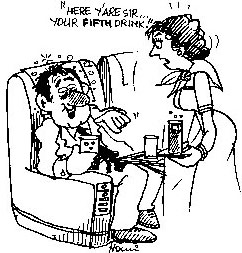
It is incumbent on the cabin crew to take care of you during a flight. Once, when I was flying on Japan Airlines, both the cabin temperature and the supply of blankets were unusually low. When I complained of the cold, a steward offered me his jacket. I declined politely, of course, but thought the gesture a fine one. A colleague narrated an incident in which he asked the stewardess for an extra drink during a meal. She replied, "You already had one", and refused to serve it to him as she was busy. A second and a third request were made to no avail, after which he lost his patience and asked to speak to the chief steward. He was busy, she informed him. On further enquiry, he was told that the captain was also busy. He finally threatened to walk up to the cockpit to complain about the rude behaviour, at which the stewardess promptly served him his drink, thinking the matter would end there. When she realized he intended to complain anyway, she apologized profusely and confessed a complaint would cause her to lose her job as she was only a trainee.
While there is little need to be excessive in your demands, it is important for an international traveler to be given the rights due to a passenger, and to be served food, drink or , blanket, for example, in reasonable time. If this does not happen, ask to see the Chief steward and request a complaint form. Particular care on this point must be taken if you are traveling economy because cabin crew are sometimes overstretched and the crew-passenger ratio on a full flight can make it quite tough on them. Passengers are also known to have made a nuisance of themselves at times, especially drunken ones. There are also other more basic things to watch out for: presurrisaiton and dehydration. Presurisation results in an expansion of the body, rendering tightfitting clothes, and shoes in particular, uncomfortably tighter. Dehydration results not only in thirst, but also fatigue and a general feeling of ill-being. The solution is to wear loose, comfortable clothing and drink plenty of water. To counteract the effects of pressurization, wear spectacles instead of contact lenses. Dehydration is kept at bay with plenty of nonalcoholic, non-carbonated beverages - that is, water and juices. To combat its external effects, a generous application of moisturizer on the face, neck and arms helps. Dandruff also gets more pronounced during and after flights because of the excessive dryness in the atmosphere, hence people with dandruff should consider using anti-dandruff shampoo prior to and after the flight. The discomforts of flying may not end with merely an itchy scalp. Some medical experts claim that flying is hazardous to the health, especially for older people. Those over 40 have less oxygen in their bodies to begin with, making them especially vulnerable to blood clots, chest pain and hypoxia (lowered oxygen levels in the blood). Blood clots are also caused by being force to sit in cramped seats for long periods of time, it is claimed. To help ease such problems, drink lots of water and eat light food. Avoid aerated beverages as the gases in them add to body expansion through stomach distention- a pity when champagne, that most aerated of drinks, is being served on a complimentary basis on flights. Alcohol of any kind is, of course, diuretic, as tea and coffee, and must always be supplemented with plenty of non-aerated fluids if you want to arrive in better shape. On the food front, stick to light meals and snacks. I remember the case of a friend who, on a long haul to Japan, happily ate everything he was offered, little realizing that he was consuming four rather large meals in the space of 17 hours. He also drank everything that came along. The result of the over-consumption: straight to the hospital upon disembarkation! There are a variety of special meals available on flight that conform to diet restrictions which passengers may have to observe for medical or religious reasons. It is imperative to ask for these at the time of making and reconfirming reservations. Food considerations aside, in-flight temperatures tend to be low, hence a spare, easily accessed garment like a sweater or shawl will come in handy. Always ask for a blanket (and extra pillows) if you need it; there are usually enough to go around. The supply of oxygen to the cabin area is sometimes reduced on long night flights, as this is said to induce sleep. To combat stiffness of the limbs, which can be quite a problem after a long haul, try and walk around the aircraft to the extent possible without disturbing cabin crew service. Walk around, go to the toilet or just move. Do this as much as possible as it gets the blood circulation going. When you get the chance to stand up and move around, it is also a good idea to stretch and do light isometric excercises as well. When stretching or flexing your limbs, be careful not to knock your neighbour in the process. Inflight Exercises Here are some exercises you can do within the restricted space on board. Neck and Shoulders Keeping shoulders relaxed, drop your head to your right shoulder and roll it along the collar bone to your left shoulder. Hold this position for a few seconds and then roll back. Repeat five to 10 times. Rotate shoulders by hunching your back and stretching shoulders upwards, forwards, backwards and back upwards. Repeat five times then reverse the direction of rotation. Arms and Hands If you can stand up and stretch out, rotate your arms in a circular motion, one at a time. If not, place them on your seat rests and raise the lower arm up from the elbow. When your hand is at the level of your shoulder, raise the elbow till the upper arm is parallel to the thighs. Lower and repeat this 10 times for each arm. Rotate wrists in both directions, similar to the arm rotations. For an overhead stretch, raise both arms straight over your head. Grasp one of your wrists with the opposite hand and pull the grasped arm in a direction opposite to its shoulder. Hold this position for a few seconds and alternate arms. Legs and Feet Keep the ball of your feet firmly on the ground, lift your heels till you feel a stretch. Lower heels and lift your toes as high as they can go, spreading them as wide as possible. Repeat 10 times. Keep your left foot on the ground, clasp your right knee with your hands and lift it to your chest. Hold this position for a few seconds and then lower the leg. Alternate legs, lifting each one five times. If you are vulnerable to backache, a long journey can cause much stiffness and discomfort. Make it a habit to carry a small, thin cushion that can be slipped into the space between the seat and your lower back. Do not, however try to straighten the natural curve of your lower back in the process. If a cushion is unavailable, substitute it with a folded T-shirt or blanket. Also ensure that back trouser pockets are free of wallets, keys and other objects as they can affect your sitting posture and contribute to backache. Upon Disembarkation The walking that you do once you get off the plane (to get to the immigration counter or baggage claim section, for example) helps to "loosen" stiff joints a little. After checking into a hotel, some light exercise or a stroll in and around the hotel helps to relax you further. Things to do While on Board After the accelerated pace of work that usually develops before a flight (preparations for the flight itself, the holiday that follows or the calls and meetings that have to be made on a business trip), the time you spend on board is a good time to relax. However, travellers tend to get restless before long. The completely different environment in flight, coupled with the fact that there is little to do, generally stimulates thought and creativity. Pen and pad, therefore, come in extremely handy. Write letters, make notes of the things you have to do or simply sketch and doodle. Inflight reading is another activity. It can throw up interesting addresses, articles and news items. These can prove invaluable in expanding both your knowledge and information base, as well as your circle of contacts. There is a particular kind of business traveler who never misses an opportunity to make a deal. Many business relationships have developed on planes. In my experiences, American sales people are often the most active on this front, taking full advantage of the "captive audience" seated alongside them on an aircraft, and carrying this to even greater heights when bad weather grounds aircraft and causes long delays. They use the time to their advantage by throwing in impromptu presentations and sales pitches. Most people, though, prefer to retain their privacy. This has its disadvantage because, quite often, one misses the opportunity to interact with interesting people. I once started chating with a friendly neighbour who turned out to be the president of a large company in the United States. By the end of the flight, he had offered me a job in New York City which would pay me a quarter of a million dollars a year. I was 31 years old then and was earning 20% of that amount. Although I did not accept his offer, it did wonders for my ego. On another occasion, I received an offer for an interesting consulting assignment from the president of a medium-sized company operating in Europe. Unfortunately, a busy schedule did not allow me to take it up. It is certainly worth striking up a conversation and seeing where it takes you. Not very far perhaps, or only far enough for a brief encounter. However, long-lasting friendships have been made this way, or a good business deal struck. When trying to break the ice first, do pay attention to the mood of the person you are attempting to talk to. His or her general demeanour and body language will give you enough to go on. Enjoy your flight for what it offers. One of my most memorable flights was on Christmas Day, and I was traveling from the United States to Europe. The entire flight was a big party… bonhomie ran high, instant friendships were struck, and the crew and passengers shared in the spirit of Christmas. Inflight entertainment, however, can come in quite another form. I was on a domestic flight in West Africa. It was a small aircraft and I had just settled into my seat. A lady walked in holding pots, pans, what seemed to be a sack of clothes, and a basket with chickens in it. She plonked herself into the seat next to mine and nonchalantly placed the utensils in my lap! After some moments of confusion and argument, I got up and placed her utensils in the galley. The rest of the journey was relatively smooth. I was unnerved, however, to discover later than 50 to 100 different livestock were traveling on that flight as well. I also remember another flight incident which, while took place, left little space for conversation. Yet when it was over, provided many passengers with the perfect ice-breaker. The aircraft we were in had just shuddered violently and dropped about 500 feet. The captain announced, "Ladies and gentlemen, what we have just experienced was a nasty lightning strike. There is nothing to be worried about though, these 'birds' are designed to handle it!" On another occasion, en route from Lagos to Cameroon, the pilot made this glib announcement, "Ladies and gentlemen, welcome aboard. The weather is bad and the visibility is poor, but with the grace of God, we should make it!" The passengers let out a collective howl. When the captain was informed of this by the cabin crew, he was back on the microphone again, "If you don't believe what I said, just take a look out of the window!" Be cool in such cases, do not panic. In any event, there is little that you can do so you might as well make the best of a flight, even if it is bumpy. Abrupt changes in atmospheric pressure, either on account of the weather or due to the presence of air pockets, make for bumpy conditions that are no different from driving on a bad road. Most aircraft are designed to work under these conditions if necessary. While the skill of the pilot is an important factor, technological advances help a great deal on this front. |