|
The
validity of your passport is crucial as most countries
will not grant a visa to potential travellers whose
passports are valid for less than six months from
the date of issue of the visa or the intended date
of entry. A passport must also have enough blank
right hand pages for the actual stamping of visas,
and for entry and exit stamps where needed.
What
happens in actual practice is that a passport's
validity is recognized only upto the point in time
six months before its expiry date. I once slipped
up in this respect by not renewing my passport in
time, only to find that I had to make an important
business trip to the United Kingdom from my base
in West Africa. The immigration officer at my point
of departure drew my attention to this fact, warning
me that I may not be allowed entry into England.
I
went ahead anyway and at the immigration desk in
London, I pointed out my problem to the officer
examining my documents. It was a vital meeting I
had to attend rather unexpectedly, I explained,
and I had only planned to stay three days. For good
measure, I added that the business I would be negotiating
involved a major purchase from a British supplier.
The officer looked me straight in the eye, sizing
me up as it were, and said he would permit me entry,
adding that the British equipment should be purchased.
I was in and out in three days as promised, although
the proposed purchase from the British supplier
did not work out.
On
another note, even if you are not guilty of having
bought that extra bottle of liquor, it is useful
to remember the following, to avoid the hassle of
being stopped while passing through Customs:
-
Be
as well-dressed as possible; a shabbily dressed
person is more likely to be stopped.
-
The
first-class passenger is less likely to be stopped
than the economy-class passenger, likewise, the
person who looks relaxed than the person who does
not.
-
People
who are engaged in conversation while walking
are often not interrupted or disturbed.
Before
traveling, check that the following documents are
in order:
-
-
-
-
-
-
PNR (Personal Name Reference) number
-
A list of alternate connections (if a connection
is missed)
-
Copies of passport and relevant visas
The
following is a checklist of procedures to be followed
at least a day before departure:
-
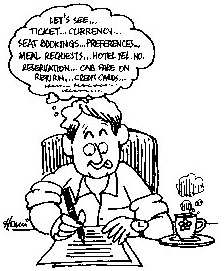
Ensure
that you have your ticket and currency at least
a day before traveling.
-
You
should have a seat on all sectors of your flight.
-
Seat
preferences should be conveyed, if the ticket
permits. Keep in mind whether the seat is to be
window, middle (if the configuration is such)
or aisle seat; on the lower or upper deck (for
first- or for business-class passengers); in the
smoking or non-smoking section, or in a specific
row or number (the first row, for instance, is
sometimes the most comfortable).
-
Ensure
that any special requests, such as those for vegetarian
meals or special assistance for disabled people
or unaccompanied minors, have been made.
-
Hotel
reservations should have been made and confirmations
received, and your hotel's address and telephone
number should be handy.
-
Find
out whether an airport tax has to be paid and
keep the exact currency amount handy. Also, pack
some extra currency of your home country according
to your requirements so that you will have enough
for telephone calls, taxi fare or miscellaneous
items for your return home.
-
Arrangements
for ground transportati0on from airport to hotel
should have been made.
-
Check
the validity of your passport and visas. Bear
in mind early in your travel plans that passport
renewal can take two to three months in some countries.
-
Check
the validity of your credit cards, calling cards
and airline membership cards.
-
At
the airport check-in desk, ensure that the extra
miles have been or will be credited to your frequent
flyer account. This should be double-checked after
travel, as airlines sometime slip up in this area.
-
It
is also useful for the frequent traveler to collect
several sets of immigration and Customs forms,
as well as arrival and departure cards, for destinations
that are frequented. These can then be filled
in prior to each departure, and kept handy in
your passport case.
-
It
is useful to memorise your passport number, its
place and date of issue, and its expiry date,
as the information often has to be filled in on
disembarkation forms. There is then no need to
take your passport out prior to disembarkation
and thus run the risk of not keeping it back safely.
-
It
is good to keep copies of important travel documents
in your briefcase and luggage (more on this in
Chapter 9).
-
Keep
a pen and a notepaper, or a dictaphone, in your
hand luggage for ready use on a flight.
-
Keep
visiting cards handy; both your own and those
of people you will be meeting.
|
|