|
 |
|
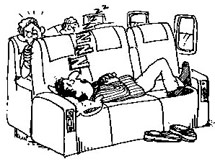
First-class air travel affords the highest level of comfort, for course, with business class coming up next and economy class being the least comfortable. However, some points are worth noting as they can help increase the comfort factor in any class. Seats in the first class are the widest, incline the furthest and allow the greatest leg room in which to stretch you legs. The simple fact that the separators between the seats in first class do not move, whereas those in the economy section do, can make for an exception to the rule that "first is best". If there is a light load in the economy class of an aircraft with a central configuration of four seats abreast, all you need to do is to lift the seat separators in one of these rows and -hey presto! - you have a bed! Savvy passengers usually take full advantage of this opportunity, keeping an eye on how the aircraft is filling up. Once the doors are shut, they home in on the empty areas, tucking themselves in comfortably after take-off. If there are no vacant rows, positioning yourself behind an unoccupied seat can spell increased comfort. Simply push forward the backrest of the seat in front and stretch your legs.
While all of this holds good even when seats are prebooked (which is increasingly becoming the norm), it also makes sense to understand the seating configuration of a particular aircraft before selecting a seat. If there is an arrangement of three seats in a row, a single traveler may not be best off in the middle. Here, the window seat may be better option if yiub are the sort who sleeps easily on a flight, because if affords more space in which to recline sideways. If you like to walk about a bit, or tend to visit the toilet frequently, an aisle seat would be more convenient both for yourself and your fellow passengers. An aisle seat also affords greater opportunity for conversation with crew members, as well as fellow passengers across the aisle. A friend married a stewardess he met thus ! Being in the front or back of the economy section can make a difference, depending on the location of the galleys and toilets. The levels of movement and noise at these points are sometimes high enough to make even a smoker kick his habit temporarily to allow him to move a quieter, no-smoking front seat. Being stuck in the central four seats-in-a-row area in the economy section is probably the worst that can happen on a long flight, but even this can turn into an advantage if the flight is carrying a light load, as described earlier. Sometimes, even though a flight is almost full, a little ingenuity and some cooperation can go along way towards a more comfortable trip. Many years ago, I found myself on a rather long-drawn, crowded flight from Africa to Europe. Three of us sat abreast on the aircraft and we took a joint decision to give up our seats two at a time, locating individual seats elsewhere in the aircraft, so as to allow the third person to sleep across the three seats in comfort. We split the duration of the flight (about nine hours), thus getting three hours of rest each. We also developed a friendship in the process and have stayed in touch since. In the economy section of most aircraft, the first row may offer the most "personal space" but you will find it hard to view the TV screen. This problem does not arise in the first and business classes, and the new aircraft of most airlines offer personal TV and video screens even in economy. There are also moves to put up additional screens along the sides of wide-bodied aircraft to ensure that viewing is convenient from all angles and seats. In economy, the seats with the maximum leg room are usually those alongside the emergency exit. It is particularly important for tall persons, especially six-footers and above, to bear this in mind. On smaller aircraft, the leg room anywhere else in the economy section may pose a tight fit for long legs. To avoid delay at the counter when booking your seats before the flight, it is advisable to find out in advance the type of aircraft you will be flying in, and what the seating configuration is like. Different airlines have varying setating configuration for different types of aircraft, and even these may change from time to time. It helps to find out these may change time to time. It helps to find out what is applicable and to update this information regularly. Pre-selection of seats is possible now in many airlines at the time of making your reservation, and it is advisable to do so to avoid disappointment during check-in. In first class, the front rows are the quietest, especially if you are trying to work. Today, with individual TV sets TV viewing is no longer a problem. In my opinion, the first-row window seat in first class is the best seat on the plane. Some flights forbid the use of TV sets, portable radios cellular phones, walkie-talkie toys, portable compact-disc players, electronic calculators, portable computers, hand held electronic games, tape-recorders, Dictaphones, hearing aids and electronic shavers during certain times such as taxiing, take-off and landing. You should find out which of these are permitted and which are not, and the times when their use on the flight is restricted. During long flights, a few simple excercises can do much to pep up circulation and dispel restlessness. They are especially useful on a fully-booked flight when it is impractical to walk up and down the aisle to provide relief to stiff joints. Motion Sickness This is believed to result when sets of information that reach the brain from different organs of balance (such as the eye and inner ear) are in conflict with each other. The brain, unable to interpret the information, triggers off the mechanism that causes nausea and vomiting. Other symptoms of motion sickness are hot flushes, cold sweats, and even dehydration and collapse. How to Deal with Motion Sickness
|