| 
While
a conducted tour is not the best way to see a place, it is an excellent
starting point in discovering a city. You will get a general feel
of your surroundings, plus basic information on the city's layout
and attractions. Once you have found your bearings, supplemented
with information from the tour guide, you are ready to explore on
your own.
The key to making the most of your travel experience is to recognize
where your interests lie. Is it in cultural activities, for instance,
or just having a good time on a Saturday night? If so, are you looking
for a noisy bar, a romantic restaurant or a trendy disco? Ask and,
in most cases, you will be told.
However much you may be bent on soaking up the local colour, it
is best to avoid the kind of place that may be termed a "clip
joint". Here, a woman will join you at your table and order
a "special cocktail"- special only in the sense that it
costs, say, US$50! There is no backing out here; the price was probably
on the menu, if only there was some light to read it by. There is
no getting away either, for there are bouncers eager to block your
exit if necessary.
While traveling internationally, if is important to speak slowly
and clearly, keeping in mind the variations in accents and pronunciations
- even for an internationally accepted language such as English.
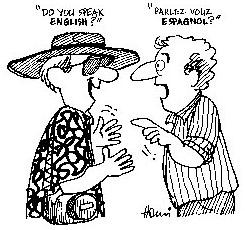
Foreign
Language Vocabulary Chart
ENGLISH |
FRENCH |
GERMAN |
JAPANESE |
| Do
you speak English |
Parlez-vous
Anglais? |
Sprechen
Sie Englisch? |
Eigo
dekimasu ka? |
| I
do not understand |
Je
ne compreds pas |
Ich
verstehe nicht |
Lie
wararimasen |
| Yes,
no |
Oui,
non |
Ja,
nien |
Haie,
iie |
| Sir |
Monsieur |
Mein
herr |
San |
| Madam |
Madame |
Gnadige
frau |
Okusan |
| Miss |
Mademoiselle |
Fraulein |
Ojo-san |
| Your
name? |
Votre
nom? |
Ihr
name bitte? |
Anata-no
onamae-wa? |
| My
name is .. |
Je
m’appelle |
Main
name ist… |
Watakuishino
namae-wa… |
| I
|
Je |
Ich |
Watakushi |
| You |
Vous |
Sie |
Anata |
| He |
I1 |
Er |
Kare |
| She |
Elle |
Sie |
Kanojo |
| Good
morning |
Bonjour |
Guten
morgan |
Ohayo
gozaimas |
| Good
afternoon |
Bonjour |
Guten
tag |
Konnichi-wa |
| Good
evening |
Bonsoir |
Guten
aben |
Konban-wa |
| Good
night |
Bonne
nuit |
Gute
nacht |
Oyas’minasaie |
| Goodbye |
Au
revoir |
Auf
wiedersehen |
Sayonara |
| How
are you? |
Comment
Allez vous? |
Wie
geht es inen? |
Ikaga
des’ka? |
| Very
well |
Tres
Bien |
Sehr
gut |
Genke
des’ |
| Thank
you |
Merci |
Danke |
Arigato
gozaimas |
| You
are welcome |
Je
vous en preie |
Nicht
der rede wert |
Irashi
mase |
| Excuse
me |
Excuse
moi |
Entschuldigensie |
Gommenasai |
| I
am sorry |
Je
le regrette |
Es
tut mir laid |
Domo
sumimaseen |
| Please |
S’il
vous plait |
Bitte |
Doozo |
ENGLISH |
HINDI |
ARABIC |
CHINESE |
| Do
you speak English |
Kya
app Angrezi bol sakte hai |
Antha
kalam Angrez? |
Ni
shuo yingwen ma? |
| I
do not understand |
Meri
samaj me nahi ata |
Mafi
maloom |
Wo
bu dong |
| Yes,
no |
Haan,
nahi/na |
Arva,
arava |
Si,
pu si |
| Sir |
Saheb |
La |
Xiansheng |
| Madam |
Memsab |
Muhalim |
Taitai |
| Miss |
Kumari |
Muhalimat
|
Xiaojie |
| Your
name? |
Aap
ka naam kya hai? |
Yush
ismak anth? |
Ni
de mingzi? |
| My
name is .. |
Mera
naam hai |
Anna
Ismak |
Wode
mibgzi shi…. |
| I
|
Main
|
Anna |
Wo |
| You |
Aap,
tum |
Antha |
Ni |
| He |
Woh |
|
Ta |
| She |
Woh |
|
Ta |
| Good
morning |
Suprabhat
kher |
Saba
Allah |
Zhao
an |
| Good
afternoon |
Shukdeen |
Leh
Allah kher |
Wu
an |
| Good
evening / night |
Shubratri |
|
Wan
an |
| Goodbye |
Phir
milenge |
|
Jaijian |
| How
are you? |
Aap
kaise hain? |
Kais
halak? |
Ni
hao ma? |
| Very
well |
Bahut
aachhee hain |
Allaham
dhru leela |
Hen
hao |
| Thank
you |
Dhanyavad |
Shukran |
Xiexie |
| You
are welcome |
Aabbhan |
Marabha |
Bu
ke qi |
| Excuse
me |
Maaf
kijiye |
|
Ma
fan ni |
| I
am sorry |
Main
dilghir hun |
Anna
ibgar |
Dui
bu qi |
| Please |
Krupaya |
|
Qing |
|


