|
 |
|
Airline tickets, if you are is looking for a bargain, may come with some restrictions. "Non-endorsable" and "non-refundable" are two common restrictions that can turn out to be not only inconvenient, but also expensive, should you not be able to adhere to your original travel plans. There may also be other restrictions that apply to advance reservations, breaks, between sectors, minimum or maximum validity, and not being able to fly on certain days of the week, for instance. Check the fine print, and understand and accept certain constraints when you travel.
Understanding the Words on an Airline Ticket An air ticket should be viewed as a document that outlines the duties and liabilities of both passenger and airline. Apart from this, it provides information about the passenger's specific travel plans. Every passenger should be in possession of such a ticket. The inside cover of a ticket is sometimes reserved for agreements that limit the liability of airlines with respect to personal injury and damage, or loss of baggage. Otherwise, it may contain general information and advice on timing, check-in, problems with overbooking, and so on. Flight coupons have a fare construction box specifying how the fare will be divided among the different airlines. This fare is sometimes expressed in terms of a common "currency" or medium of exchange called a Fare Construction Unit (FCU). The Form of Payment box at the bottom right-hand corner indicates the method of payment for the ticket. The letters "cc" indicate that payment has been made by credit card; the word "cheque" or its abbreviation, "chq", indicates payment through a cheque; and a blank space or the specification "cash" indicates a cash transaction. "Non ref" in the same area indicates that the ticket was obtained through a travel agent and that a refund is obtainable only through that agent. The section of the ticket entitled "Baggage" has a sub-section. "Allow", which indicates the weight of baggage permitted at no extra cost. Other entries, such as number of pieces, and checked and unchecked baggage, are filled in only when the passenger checks in. The various columns in the main section of the flight coupons give further information about individual flights. The column headed "Class/Fare Basis" specifies whether the ticket is first, business or economy class. These are most commonly designated by the letters "F", "C" and "Y", respectively. The "Y" may be followed by additional letters that indicate special kinds of fares. For instance, "YE" indicates an excursion fare and "YZ", a youth fare. The "Carrier" column/box has the airline code - for example, "BA" for British Airways, "DL" for Delta Airlines, and so on. Next come the flight number and class of travel, followed by the date and time. The time is shown on the basis of the 24-hour clock - that is, 5.45 pm is written as 1745. The letters "OK" in the "Status" box (which comes next) indicate that a seat on the flight has been confirmed "RQ" indicates that a flight has been requested but not yet confirmed and "WL" indicates that it has been waitlisted. If a ticket has been purchased but the passenger is likely to alter the date and time of individual flights, the word "OPEN" is written across the space for individual flights, indicating that the passenger has not decided when he or she wants to travel. In
some countries, travel agents issue "universal" tickets
that are not designated as belonging to specific airlines. Instead,
at the time of issue, a special plate is incorporated in the ticket,
serving as the stamp of the airline that has issued it. This is
done for the sake of convenience. Tickets issued directly by airlines
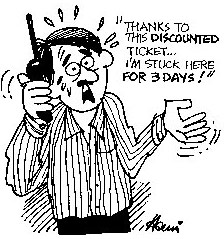
carry their usual identification. Restrictions and Options Fares bought at low prices, such as excursion fares,, typically come with various restrictions. While traveling within Europe, I once found myself having to make an unexpected trip to the United States and back I bought a discounted ticket in Barcelon and flew to New York, only to discover that I would be stuck there three extra days in order to honour the restrictions it carried. I also found that the discount offered was not big enough to justify such as a restriction. The delay would have cost me hundreds of dollars and a great deal of valuable time as I was on a work assignment. I ultimately had to throw away the discounted ticket and bought myself a new one.
If the ticket being bought is free of restrictions, you may like to leave the boxes for onward journeys blank. Do make reservations for these onward flights, but do not have the data entered on the ticket. If you are traveling, say, from Rome to London to New York on Swissair, and need to change to another carrier (or another date of travel) in London, all you need do is make a telephone call to the respective airlines, instead of going through the time-consuming and expensive process of actually visiting their offices. Therefore, always ask for and carry a computer printout of your reservation details, rather than having all the information filled in on your ticket. This allows for easier changes in itinerary while traveling. Once, while I was in London in the midst of a busy schedule, I spent four hours just trying to change my flight. First, I had to get endorsement of the airline stated in the "box", then call at my new choice of airline for my seat, only to learn that the seats that were available only a couple of hours ago were no longer available by the time I got there personally. So I found myself back to the traveling on the original airline and all that time spent running around was in vain. Restrictions are not the only consideration when buying an airline ticket. There are certain sectors - for example, from Asia to the United States at the end of August and in early January, when students return in large numbers of their holidays - for which bookings may have to be made up to a year in advance. Kinds of Fares Various types of air tickets are available in the market, offering a range of fares and encompassing a broad spectrum of conditions and restrictions. The following are the most common types of fares: First Class These fares are usually valid for a year and are almost completely flexible. Reservation date, time and even choice of airline can be altered. Stopovers are also permitted. Mileage deviation of 20% to 25% is allowed at no extra cost. Benefits include high quality in-flight service, a better selection of food and drinks, a larger baggage allowance (usually upto 40 kilograms), more comfortable seats and the use of special lounges during connection stopovers. This class of travel has the business person in mind. It can cost anywhere from 5% to 100% more than the economy fare. It is generally flexible and allows a mileage deviation of upto 20% at no extra cost. Benefits include more comfortable seating, and better in-flight and ground service than what is available on the economy fare. Special lounges and separate check-in counters are also available. Point-to-Point Economy Such a ticket is valid only for travel between the two stated points and does not allow for stopovers. It is relatively inflexible and cannot be used for connecting flights with another airline. Excursion An excursion ticket is usually 25% to 30% cheaper than the regular economy fare. It allows changes in departure date and time but restricts the length of your stay. Excursion fares sometimes increase with an increase in your intended length of stay. Advance Purchase Excursion (APEX) This is a discounted ticket that is booked and paid for a week to a month in advance of the travel date. It can involve as much as a 60% discount off the regular fare. Such fares are usually for two-way trips and require a minimum period of stay. Stopovers are not permitted. Standby While such fares can be bought in advance, a seat cannot be guaranteed until the day of departure or just prior to departure. Such fares are generally offered on domestic flights within the United States at a greatly discounted price. However, they should be bought only if you are prepared to abort the trip if the flight is full. Round-the-World Ticket This offers a round-the-world service that is relatively cheap. However, you have to make a minimum number of stopovers and are required to travel onwards; "backtracking" is not allowed. While the initial flight has to be booked upto a month in advance, later flights can be booked during the journey. |