|
 |
|
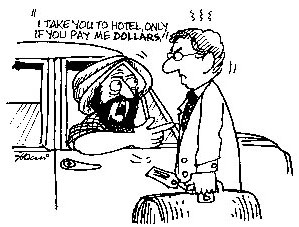
From the moment you arrive at your destination, a variety of travel options await - from hiring a private limousine complete with telephone, TV set and bar to taking the bus. The choice, of course, depends on your budget, the quality and availability of public transport, and the time of day (or night). To make the vest decision, you should know before hand what the options are, even if you are a business traveler with an expense account. It is also vital to be prepared in advance for the type of transport you are planning to use. In Hamburg, I once boarded an airport bus for the short ride to my hotel. ON the bus, I realized that the few marks I thought I had were actually not where they should be, and offered the driver the fare in an equivalent amount of U.S dollars. He would have none of this and stopped the bus which had just pulled out of the airport. Summarily off-loading me and my large suitcase which served as both luggage and wardrobe. His parting message was loud and clear and has remained with me ever since. "In Germany," he said, "we pay with marks." If there are plans to hire a car, check out the scene in advance, where possible with international companies like Hertz or Avis. Look for quality, reliability, price and availability. Also, take the local public transport infrastructure into consideration and hire according to your needs. In Hong Kong, for example, the taxi system is a good one, with taxis being reasonably priced and readily available and organized. This holds good in Singapore too, where the walk and wait for a hired car at the airport is slightly longer. In a country like Switzerland or in Scandinavia, local taxis are rather expensive but there is an excellent choice of public transport systems. In some developing countries, the local taxis are in bad shape and the driver may be out to cheat you. Sometimes, however, no taxis are available at all. In this case, it is best that transport be prearranged.
At one airport I had just arrived at, a burly cab driver threw my bag into the book of this car and we shot off at full speed. I told him where I wanted to go, to which there was no acknowledgement. He soon got into a race with other cab driver and I realized then that he was drunk. I asked him to slow down, to which he replied that he would do so only if I agreed to go on a tour of the city with him before he drove me to the hotel. I reluctantly agreed. A while later, I suggested we could make a deal whereby he could take me on an even longer tour, as I was fascinated by the place, and inquired about the various sights that interested me. However, I explained that I had to check into the hotel first as I would lose the reservation beyond a certain time. He acceded to the request. When we finally pulled up at the hotel, I went in and complained to the manager who I insisted, should settle the bill himself. Presently, the taxi driver barged angrily into the reception area and had to be held down by security personnel. The police were called in for good measure. In developing countries, the taxi service provided by or linked to hotels is usually more expensive, but also safer and more reliable than the general taxi system. Hence one should make a careful evaluation of the preferred mode of transport based on budget, time and specifics of the place in question. While it is always useful to hold a driving licence that is valid internationally, weigh the benefits of driving yourself around against those of being chauffeured, either by hired care or even by the local bus driver. For example, you may be used to driving on the right side of the road, but there are several countries where driving on the left is the norm, bringing with this practice a whole new set of rules to get used to. Checking in at Hotels After you check in, see if you have access to the front desk via the telephone line. Sometimes telephones are switched off in the period right after a person has checked out and before the next person checks in. Count the number of doors to the fire exit in case you have to grope your way around in the dark should there be an emergency. Ask the person who checks you into the room to show you the various light switches and the music and television systems. Sometimes, even instructions on the operation of showers and taps may be needed! Make sure you have enough pillows and blankets, and do not hesitate to ask if you need extras. Find out the operating hours of facilities such as restaurants and shops. Make sure to check into the hotel safe all important things like passports, travel documents and traveller's cheques. Even the best hotels are known to have fallen prey to burglaries committed by sophisticated burglars posing as guests and actually living in the hotels to steal. Keep a close watch on your briefcase or handbag while in the hotel's restaurants. Specialist thieves hang around these places, sitting at tables close to their victims and stealing or swapping their briefcases when the opportunity arises. Keep a light, radio or TV set on in your room even when you are not in. This will help to deter would be burglars. If you find that you need extra time at check out, do not hesitate to ask for it at no extra cost.
|