|
 |
|
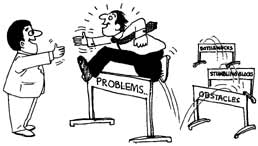
It has been a long road of analysis and evaluation, application and enumeration. From vision to strategy, corporate profiling to SWOT analysis, industry evaluation to country competitiveness, partner profiling to choosing the optimum tie-up, we have now identified the ideal partner. Conceptual Problems The problems are numerous and critical. Getting it right starts at the beginning. Thorough research is required in three areas:
Government-related Problems
Often
one plunges into a country without making a detailed assessment
of government policies, the government in power and the opposition.
It is important to be informed of the current policy towards foreign
investments and the likely impact that a change in government will
have. Hence, a clear understanding of the economic policy of the
government and the macro-economic situation within the country is
needed. In dealing with government officials, one should also assess what the expectations in terms of "favours" or "friendships" are, as people in governments around the world often have different priorities based on their value systems, compensation terms and other factors. Finance-related Problems
Many times, when the cost factor has not been properly considered, the result would be delays, abandonment of projects or sell-outs. It is therefore better to provide for generous margins of cost overruns, not only because of inflation but also because of changes in concept, expansion in size or improvements in technology. These invariably come up at various stages, from project conceptualisation through to implementation. Time Schedule-related Problems Allow TWICE (than when operating in a known/home environment) the usual time for:
Through effective project management techniques and a good project team, one can keep project time under control. Other factors that require external approval and input must be provided for adequately as processing time could be much longer than promised earlier. In terms of time planning, the approval process multiple agencies such as the World Bank, local governments and even local financial institutions, as well as the establishment of an infrastructure by outside agencies, should also be provided for adequately. Problems Related to "Them" Here we must be careful to ensure that we know the culture, value systems, business objectives, vision, mission and strategy of the owners of the business. This is not only important for the current situation, but also for the future. For instance, it is possible that when the younger takes over from the older generation, there may be a change in both business direction and business philosophy, and one should be prepared for such potential changes. Similarly, if there are partners, quite often splits take place. In a family business, members of the younger generation may have different approaches compared to their elders. Such eventualities should be taken into account.
You must be careful about being over-enthusiastic with partners who have strong political affiliations. One could be very much in favour one day, but, with a change of government, fall out of favour the next. Hence, it is advisable to have partners who manage to get things done and are politically neutral. Problems Related to "Us"
It is important that you are committed to the venture and provide all the necessary inputs. Problems Related to the "Partnership"
Thus make sure of the fact that we are in a synergistic situation with both parties giving and taking a reasonable amount and willing in the long term to be flexible and adaptable. What you should bear in mind is that, as in a handshake, there is no upper hand; both hands are at the same level.
The Big Move
A host of potential problems concerning the project, 'the place and the partners involved must be critically and carefully reviewed before embarking on a joint venture or alliance. Only then can we go from a two-dimensional to a three-dimensional sphere with global joint ventures and alliances... Are we ready for the QUANTUM LEAP?
|
||||||||||||||