|

| Looks
at |
|
|
Company's
strengths |
|
|
Company's
weakness |
|
|
Opportunities
available |
|
|
Threats
faced |
Strengths
- Does
the company have a core competence?
- What
is it?
- What
are the company's strengths?
Examples
:
-
Market size
- Committed people
- Financial resources
- Infrastructure
- Strong technological base
| McDonald's
Fast Food: From Strength to Strength |
|
In
the mid-1950s, there was a hamburger restaurant in San Bernardino,
California, which was owned by Richard and Maurice McDonald.
The potential of fast food as a lifestyle preference to meals
became apparent to Ray Kroc, then a milkshake salesman. Kroc
further developed the fast food concept, creating the legacy
that is McDonald's today. His strength thus lay in his ability
to capitalise on the changes in people's lifestyles.
|
| NEC:
Rethinking the corporation |
|
During
the early 1970s when computing and communications began to
converge, NEC, wanting to take advantage of this trend, identified
interrelated streams of technological and market evolution.
The strategy entailed becoming competent in the semi-conductors
business and building up the strengths in this line to cash
in on segments: computing, communications and components.
This resulted in a redefinition of its core competencies in
order to maximize emerging opportunities.
|
| Canon:
Core Competencies |
|
Canon's
core competencies lay in optics, imaging and micro processor
controls. This gave it dominance in diverse businesses like
cameras, copiers and laser printers.
|
| Honda
and Chrysler: Differing Visions |
|
The
differing visions of their core competencies took Honda and
Chrysler along different paths. Honda viewed its core competencies
in engines and power trains - which gave it long-term business
advantages in cars, motorcycles and enerators. Chrysler, on
the other hand, perceived engines and power trains as just
components and chose to outsource these from Hyundai and Mitsubishi.
Failure to develop these strengths has negatively affected
Chrysler's product leadership position.
|
Weaknesses
-
Are we now better able to identify our weaknesses?
- What
areas are they in?
Examples:
-
Technology
- Quality consciousness
- Research and development
- Poor people commitment
- Poor money management
| EMI:
Weak Links |
|
Despite
its competency in research and development and its success
in X-ray scanners, EMI failed to gain dominance in the medical
electronics industry. EMI's weakness was its failure to develop
capabilities in manufacturing high volumes at low cost to
establish sound service and distribution networks within the
USA.
|
Opportunities
- What
are the opportunities available?
Examples:
-
New markets
- New products or product redefinition
- Higher volumes
- Cost economies
- Government policy changes
| MCDonald's:
Growth in Diversity |
|
McDonald's
and Coca-Cola are often perceived as symbols of homogenisation
of tastes and markets, and therefore cultures. But what is
important is what they mean to people in each culture. Eating
at McDonald's is a show of status in Moscow, but in New York
it's "a fast meal for a fast buck".
|
| Weaver
popcorn: An Opportunity met well |
|
America's
Weaver Popcorn was reputed for providing quality products
for 59 years. Yet their first sales to Japan were ejected
when the Japanese quality inspection found some impurities
in the popcorn. Weaver did not give up. They installed sophisticated
optical inspection equipment that cost over half a million
dollars and went on to gain 60% of the Japanese popcorn market.
|
| Compfrio:
Capitalising on opportunity |
|
Compfrio,
a well-established Spanish company in the business of processed
meat manufacturing and a market leader in its own country,
is capitalising on its competitive advantage.
The
Spanish consumer of a few decades ago is similar to the consumer
in the developing countries of today. Thus Compfrio products
are ideal for emerging markets in countries such as Russia,
Mexico and the Philippines. The product's shelf life is long
enough to survive slow, long distribution lines. What is seen
as "overprocessed" in Western Europe, is ideal for
the developing world where refrigeration is not always guaranteed.
|
| Canon:
Converting a threat into an opportunity |
|
Faced
with the onslaught of Xerox, who came with a huge direct-sales
force and a financially engineered sales plan, Canon managed
to convert these threats into opportunities by:
-
Distributing its copiers through office- product dealers
- Choosing
to sell outright rather than lease as Xerox did, thereby
freeing it from huge lease servicing costs
- Building
reliability and serviceability into its product, and thus
doing away with the need to create a national service network
- Delegating
the service responsibility to its dealers.
|
| Swiss
Watches : Product Respositioning |
|
In
the wake of quartz watches, the Swiss watch industry was faced
with a declining market. The launch of the "Swatch"
heralded a new market that looked at a watch not just to tell
time, but as a fashion accessory too.
|
Where
is the optimum opportunity for us?
- Where
does it lie?
- How
do we locate it?
Threats
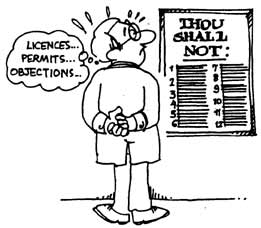
Examples:
-
Competition
- Government legislation
- Geographic limitations
- Technical obsolescence
| Ford
Motors: Supply Threats |
|
When
the Ford Motor Company of Australia took stock of its business
after the 1986 setback in its profits, one significant threat
to improved operations that loomed large was the level of
disrupted industrial relations at its suppliers. Having changed
to a JIT inventory system meant Ford was increasingly vulnerable
to any disruption to its supply of components.
|
| Canon:
Threat into an opportunity |
|
Xerox's
decision to rent or lease its copters to customers, as opposed
to an outright sale, provided them with financial advantages.
This posed a significant threat to Canon's markets. In order
to deter the entry of Xerox into the personal copier market,
Canon needed to improve its price-performance. Rather than
reduce the price of its existing models, Canon challenged
its engineers to reinvent the copier and set a target price
of $1,000 for a home copier. The result: the complex image
transfer mechanism was substituted with a disposable cartridge.
|
What
we have done so far is define our vision and corporate strategy,
and create a descriptive document of our company which will act
as a sound basis for further analysis. From a basic review of the
company in all aspects, we moved via a SWOT analysis to a review
of our potential from a global perspective. We now need to focus
on the optimum opportunity.
|



