| 
| Looks
at |
| |
Cultural
mindsets - historical perspective |
|
Culture
- related problems |
Playing
the International Game Locally
Most businesses are founded on human relationships and friendship
and hence relationship-building is basic to successful business
management. Even more so in global markets where every country is
an amalgam of languages, traditions and cultures. While business
strategies may ensure direction, such direction acquires smoothness
when a foreign entrant endeavors to become an "insider"
in the chosen country. Culture has its roots in years of evolution
of a people in a defined climatic, geographic, historic and economic
environment and includes the socially transmitted beliefs, value
systems and behaviour patterns.
Understanding cultural differences is useful in global deal-making.
As culture lends meaning to words and actions, a skilled negotiator
must learn the culture of the country he has chosen in order to
prevent foul-ups.
| Cultural
Responses |
Temperament
is one sub-set of culture and should be taken into account
during negotiations. For example, the American impatience
(progressiveness) and the Japanese fastidiousness (precision)
could create difficulties in business talks if the respective
cultural responses are not understood. The Japanese tend to
be reflective, and negotiations with them are likely to be
punctuated with periods of silence, which could agitate an
American. Very often, the silence is misunderstood and the
American is likely to fill the contemplative moments with
more words. The reflecting Japanese, in turn, feels rushed
and confused. In the case of an American company trying to
win a contract with a South American firm, disregard for the
importance of the relationship lost the deal. The American
company (with a superior product and lower price) made a slick,
well-conceived presentation, period. Its Swedish competitor,
however, took an entirely different course, spending a week
in getting to know the customer, discussing everything except
the product, which was introduced only on the last day. |
| SONY:
Concern for others vs. Concern for self |
Sony's
chairman, Akio Morita, conceived the idea of the Walkman by
his desire to listen to music en route to work without disturbing
others. The Walkman is popular in America for the opposite
reason - it cuts off disturbance from the outside world to
the listener! |

| Status
consciousness: Cultural symbolism |
Hierarchical
differences can also cause problems. Perceptions of status
are often made on the basis of some status symbols. A British
general manager in Bangkok preferred to drive a small car
which is more maneuverable in Bangkok's traffic. However his
Thai team found it impossible to agree to his request, because
if he drove a small car they would be obliged to ride bicycles!
Hence he was forced to drive a Mercedes-Benz. |

| Importance
of Age |
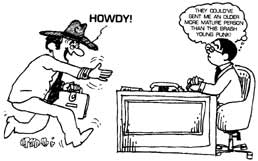
In
some traditional cultures, when people are asked to deal with
someone who is ten to twenty years younger than them, they
feel offended, even though the younger person may be well-qualified,
competent and experienced. For instance, the Greek, the Italians,
the Japanese and most Asians would be offended dealing with
very young Americans or Europeans. |
Past, Present, Future: Cultural Mindsets
The outlook towards the past, present and future varies in different
cultures. Depending on their history, different cultures emphasise
different periods of time. For instance, older civilisations like
the Chinese and Indian, which have existed for thousands of years,
tend to focus on the past and hence their history, tradition and
cultural heritage is important to them. Thus an understanding of
these is important in dealing with them more effectively. On the
other hand, future-oriented people with short civilisation histories
like the Americans, emphasise freedom and opportunities for the
employees and the company in the future.
| TIME:
ATTITUDES AND APPROACHES |
Time
is viewed in a variety of ways in different cultures. The
Americans, for example, are sequential in their approach,
doing only one activity at a time, keeping appointments strictly,
scheduling in advance and not running late. In contrast, the
South American or Middle Eastern approach is one where appointment
times are approximate, meetings may start late and telephone
calls and other visitors upset schedules. |
We
have discussed in earlier chapters how the choice of country can
be made through analysis, evaluation and comparison of various countries.
Similarly, we have seen the importance and complexities in the search
for a partner and have developed formats and approaches to partner
evaluation. Understanding cultural differences is important in determining
the success of a business deal.
However,
equally important is the size of the project - proper feasibility
studies should be carried out by professionals. The size of the
project should be determined after consideration of all factors,
including the all-important aspect of extrapolation of future demand
which takes into account market, competition, government policies,
environmental factors, etc. Often "gut feeling" is depended
on to determine project size. This could cause great difficulties,
risking the viability of the project. The other important aspect
in considering project size is available funds. Companies frequently
embark on projects beyond their means. Hence, the right balance
in terms of project size and funds availability should be ensured.
|



