|

| Looks
at |
|
|
Corporate
Strategy - its focus |
|
|
Global
players |
|
|
Geographical advantages |
What
is our Corporate Strategy?
- High
technology
- Product
innovation
- Market
extension / penetration
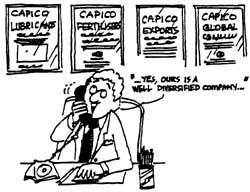
- Diversification
| Wal-Mart:
Success via Strategy |
|
Wal-Mart's
road to success was built on a set of strategic business decisions
that transformed it into a capabilities-based competitor.
Wal-Mart defined its goals as quality, delivery and price
effectiveness; it could achieve these by making inventory
replenishment the pivot of its competitive strategy.
|
| Canon:
Innovation Strategy |
|
Xerox
invented xerography and opened up the office copier market.
But by 1982, Canon introduced more than 90 models and cut
Xerox's share of the market by half.
|
| Elgin
Corrugated: Value Addition |
|
Elgin
Corrugated Box Company from Illinois does not consider its
boxes as mere commodities. Elgin added value to its products
at every step of the production process (e.g. printing ink,
flute corrugation), and gained a clear advantage in an otherwise
dying industry.
|
Do
we see ourselves as potential global players? If so, why?
- New
markets
- Economies
of scale
- Competition
- Advantages
of geography
According
to Gary Hamel & C K Prahalad, global leadership is an objective
that lies outside the range of planning. Global market leadership
often stems from where there is a clear strategic intent. In their
opinion, companies that are afraid to commit to goals outside the
range of planning, are unlikely to become global leaders.

| Airline
Companies: Global tie-ups towards greater efficiency |
|
Recognising
a potential in global operations, airlines around the world
are seeking closer tie-ups with one another to gain economies
of scale. Some examples:
- Lufthansa
with Air France
- Singapore
Airlines with Swissair and Delta
- Alitalia
with Iberia and US Air
These
are just a few of the many airline alliances that are emerging
around the globe every day.
|
What
are the geographical advantages ?
- Proximity
to markets
- Proximity
to raw material sources
- Lower
labour costs
- Savings
on logistics costs
- More
favourable legislation
| The
Maquiladora Programme: Geographical Advantages |
|
The
relationship between the USA and Mexico typifies capitalizing
on geographical advantages towards export business growth.
The availability of an industrially disciplined and low-cost
labour force, combined with a desire to increase exports,
prompted Mexico to set up its maquiladora programme in 1965.
This programme enjoys preferential tax treatment from the
USA as well as privileges in Mexico, such as 100% foreign
equity ownership. Known also as twin plants or in-bond manufacturing,
it permits manufacturers to import into Mexico raw materials,
components and machinery free of import duty, provided most
of the output is exported. Similar zones also exist in various
Asian countries.
|
We
have so far defined our vision and the corporate strategy. If we
can, and wish to, gain significantly in some of these areas, let's
take a closer look at what we have - our own corporate profile.
|



